
 Search Articles


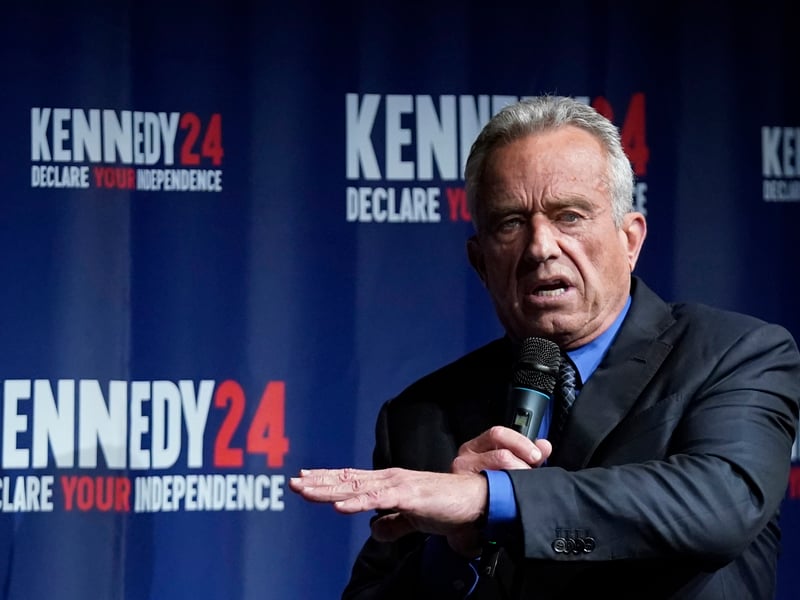
(CN) — Independent U.S. presidential candidate Robert F. Kennedy Jr. announced Friday that he is suspending his campaign and, in a break from family tradition, endorsing the Republican nominee, former President Donald Trump.
Backing the Republican nominee would have once seemed unthinkable for Kennedy, who was a Democrat for most of his life, and is the nephew of former President John F. Kennedy and son of Robert F. Kennedy — two beloved Democrats.
But after meeting with Trump, Robert F. Kennedy Jr. said, he was surprised to learn they were aligned on issues like freedom of speech and the war on Ukraine. Kennedy also criticized the Democrats, saying the party has departed dramatically from what it used to be, when it “stood against authoritative censorship, colonialism and unjust wars.”
“We were the party of labor, the working class, government transparency, champion of the environment. It was the party of democracy,” Kennedy said of the Democratic Party.
Even before Kennedy made the announcement in Phoenix, Arizona, where Trump was also scheduled to hold rally in the suburb of Glendale, the end of his campaign seemed inevitable.
“Kennedy never had a chance to come anywhere close to winning — not even in a single state,” University of Wisconsin political science professor Kenneth Mayer said in an interview.
“It was a vanity campaign, that’s all. If his last name were anything other than Kennedy, he’d be the guy at the end of the bar ranting about chemtrails,” he added.
After leaving the Democratic primary to run as an independent last year Kennedy garnered an unusually large amount of support from voters dissatisfied with both Trump and President Joe Biden. His popularity was stunted after Biden ended his reelection campaign and Democrats coalesced around Vice President Kamala Harris.
Last month, according to a Pew poll, Trump led Biden and Kennedy earned 15% of respondents’ support. In the latest survey, Harris was up and Kennedy’s support had dropped by more than 60% — with nearly 40% of those who backed him in July shifting to Harris while 20% switched to Trump.
Kennedy’s running mate Nicole Shanahan previewed the possibility of a Trump endorsement this week on the podcast Impact Theory, where the San Francisco attorney and businesswoman said the Kennedy campaign may “join forces” with Trump to limit votes for Harris, who accepted her party’s nomination at the Democratic National Convention in Chicago on Thursday night.
In response to reports that the move was coming, some of Kennedy’s supporters expressed plans to vote to Trump in November. Others were disappointed, according to posts in the Facebook group “RFK Jr. for President 2024.”
“That RFK would even consider trading all our good grassroots work and sweat equity on this campaign for him, in return for a position in the Trump administration, either administration frankly, is sad,” wrote Florida voter Curtis Michelson.
The longshot candidate’s exit was unsurprising given the trends of the two-party system, Mayer explained.
“Since the modern two-party system emerged in the mid-19th century, no third party has been competitive nationally,” Mayer said. “Winner-take all elections, legal advantages for the major parties in ballot access and position, and the major parties as key organizations at the local, state, and national level make third parties relevant only as spoilers.”
Even by third-party standards, however, Kennedy ran “a particularly poor campaign, said Valdosta State University professor Bernard Tamas.
Past popular third-party candidates stood out by taking positions that made them distinct from both the Republican and Democratic candidates, said Tamas, whose research focuses on electoral bias and U.S. third parties.
“Consider RFK Jr.’s political strategy as a counterpoint to this approach. Instead of seizing upon a galvanizing issue that distinguishes him from both major parties, he has presented a hodgepodge of policy positions that are indistinct from either party positions,” Tamas said in an email interview.
He noted that Kennedy spent a majority of valuable campaign time discussing conspiracy theories like as his avid skepticism over the effectiveness of Covid-19 vaccines during the pandemic. Kennedy may have gained popularity with the anti-vaccination movement, but he was also banned from most social media sites for spreading misinformation.
Kennedy also failed to capitalize on the anger of a sizable number of voters outraged at both Trump and Harris, Tamas said: those calling for a cease-fire of Israel’s war on Gaza. And Kennedy has remained evasive about abortion, another highly galvanizing issue in this election.
“Unlike Green Party candidate Jill Stein and Libertarian Party candidate Clive Oliver, Kennedy’s campaign does not appear to be driven by a galvanizing policy goal. He is likely dropping out to avoid the embarrassment of getting far fewer votes than people had expected,” Tamas said.
Although he is suspending his campaign, Kennedy said his name will still appear on some ballots and encouraged people to vote for him, but said he is removing his name from the ballot in battleground states.
Kennedy called the decision “heart-wrenching,” but said it would advance his primary goal of ending the chronic disease crisis in America. “I can’t imagine Harris would allow me to solve these problems. Trump has told me that he wants this to be his legacy. I’m choosing to believe this time he will follow through,” Kennedy said.
The 70 year-old politician and environmental lawyer said he feels he has a moral opportunity to save the “dire condition” of American children’s health by working to reform the production of highly processed and industrial manufactured foods.
“Today we spend more on healthcare than any other country on earth yet we have the worst health outcomes,” Kennedy said.“This is a crisis. No one else in the world is experiencing this,” he added.
Kennedy’s decision came a little over a week after a New York judge ruled that he did not meet New York residency requirements and therefore cannot appear on the state’s ballot. Kennedy appealed, but has since faced several similar challenges to his eligibility around the country. On Friday he accused the Democratic National Committee of waging “legal warfare” against his campaign.
The challenges increased the unlikeliness of Kennedy qualifying to appear on the debate stage next month when Trump and Harris will face off for the first time. Indeed, Kennedy’s campaign took a big blow in June when he was not allowed to participate in the CNN debate between Trump and Biden, and instead held a separate event where he responded in real time to the CNN moderators’ questions.
His campaign was weathered, too, by a series of bizarre scandals in recent months, from his response to sexual assault allegations to his admission that a worm ate part of his brain to publicizing — apparently to get ahead of an unflattering story — that 10 years ago he left a six-month-old dead bear in Central Park after initially planning to skin it for meat.
 Follow @Megwiththenews
Subscribe to our free newsletters
Our weekly newsletter Closing Arguments offers the latest about ongoing trials, major litigation and rulings in courthouses around the U.S. and the world, while the monthly Under the Lights dishes the legal dirt from Hollywood, sports, Big Tech and the arts.