
 Search Articles


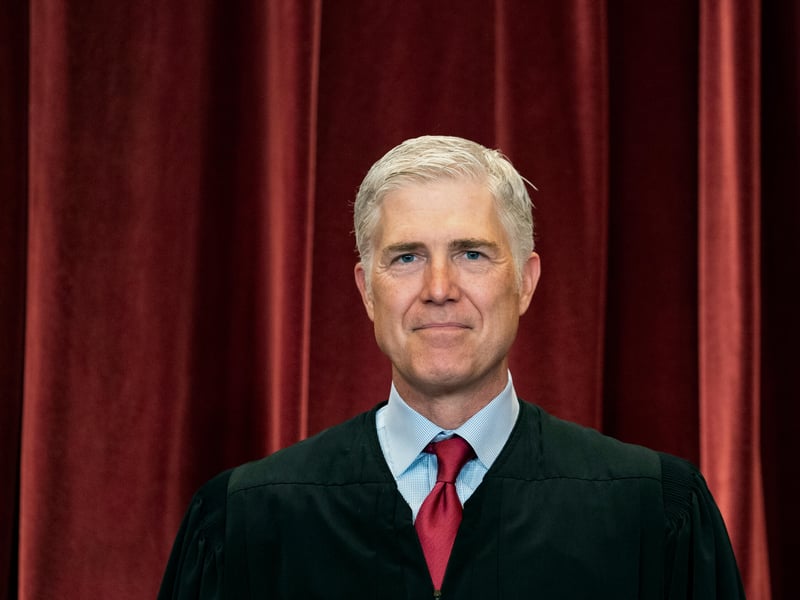
WASHINGTON (CN) — As a new Supreme Court term dawned this week, so did new questions about the justices’ ethical standards, this time focusing on Justice Neil Gorsuch’s ties to an oil billionaire.
The Donald Trump appointee is being called to recuse from an environmental case on the high court’s docket, Seven County Infrastructure Coalition v. Eagle County, Colorado , because of his cozy relationship with Philip Anschutz. The owner of Anschutz Exploration Corporation stands to benefit heavily if the court greenlights an 88-mile oil and gas rail line in Utah.
“The cozy relationship between Philip F. Anschultz and Justice Gorsuch far surpasses the standard of ‘reasonably questioned impartiality’ for the federal recusal statute,” watchdog group Accountable.US and others wrote in a letter to Chief Justice John Roberts on Thursday. “This relationship that creates a conflict of interest is just the latest example of countless violations in the yearslong Supreme Court ethics crisis.”
The letter signed by just over a dozen advocacy groups highlighted the consequences of the court’s stagnation on this issue. After years of ethical scandals surrounding the justices, there are still many open questions over when the justices need to recuse and how that decision is made.
“It certainly seems emblematic of the broader problem of there not being a specific and descriptive code of conduct that the justices need to follow that’s enforceable in any way,” Sarah Turberville, the director of The Constitution Project, said in an interview. “Perhaps in this case, it’s illustrative of the need for an ethics council who’s available to really provide specific guidance to the justices.”
Gorsuch served as counsel to Anschutz and his companies in the early 2000s. The Trump appointee has detailed annual hunting retreats on Anschutz’s estates and even bought an investment property with Anschutz business associates.
Anschutz’s oil wells in Utah’s Uinta Basin could benefit from the contested railway, which would cut the company’s freighting costs and increase profits, according to Accountable.US. His company filed an amicus brief before the court, urging the justices to ruling in favor of the line’s construction.
“Anschutz urges the court to confirm that Public Citizen limits the scope of an agency’s NEPA analysis — consistent with NEPA’s purpose to foster informed agency decision-making — such that an agency need only study those environmental effects over which the agency has regulatory authority,” the company wrote in its brief.
NEPA, the National Environmental Policy Act, requires government agencies to assess the environmental impacts of industry projects. The high court’s review puts NEPA in the crosshairs.
“The Supreme Court has long been not a fan of the NEPA, but this case will allow it to speak broadly on exactly what kind of impacts are to be considered,” Lisa Heinzerling, a law professor at Georgetown Law, said. “When this comes to climate change it’s really important. A rail line that didn’t exist before, that can make waxy crude oil available in great quantities when it might not have been available before has huge climate impacts.”
With oil and gas operations in Colorado, Utah and Wyoming, Anschutz must undergo a Bureau of Land Management environmental review for every development in its portfolio.
“Because NEPA applies to every major federal action — including the authorizations Anschutz needs to develop federal oil and gas reserves — far more is at stake in this case than the 88-mile rail line in rural Utah,” Anschutz wrote.
Accountable.US says rolling back the law would lower Anschutz’s regulatory costs and drive up its profits. The watchdog argued that Gorsuch’s relationship with Anschutz creates questions around the justice’s impartiality — the standard for recusal under the federal statute.
While the advocacy groups claim Gorsuch’s recusal is warranted, the justice himself will be the one to decide whether he hears the case.
Gabe Roth, executive director at Fix the Court said recusal calls on Justices Clarence Thomas and Samuel Alito presented much clearer conflicts. The same can’t be said here.
“It’s a little bit more attenuated, and it would be worth having someone file a complaint to a neutral body that could then look into this, that would have the resources to call up, or that would have the authority to call up Gorsuch,” Roth said.
It’s been almost two decades since Gorsuch worked as outside counsel for Anschutz’s company, and currently there’s no public accounting of their relationship after 2017.
Since anyone can file an amicus brief before the court, the court does not require recusals for a justices’ connection to amici.
Ethics experts have long advocated for an independent body to conduct oversight for this exact situation. According to the ethics code, justices must recuse if a reasonable person knowing all the facts involved would believe the justice to be biased.
Roth said the problem with calls for Gorsuch’s recusal from the Utah rail case is that all the facts aren’t yet available.
“Bringing in someone who isn’t the justice him or herself to do that analysis, to look at the issue, I think, is critical,” Roth said. “It’s something that’s done in dozens of state courts and apex courts around the world, so the idea that the judges are the only ones making this decision is ridiculous.”
Aside from signing onto a code of conduct, the court hasn’t seemed moved by calls for reforms. Justice Elena Kagan, a Barack Obama appointee, however, repeatedly suggested that a committee of lower court judges could enforce their newly minted code.
“The thing that can be criticized is: Rules usually have enforcement mechanisms attached to them, and this set of rules does not,” Kagan said during a conference in July.
This year, Alito demonstrated the justice’s authority over ethics enforcement. Democratic lawmakers asked Chief Justice John Roberts to force his colleague to recuse. Roberts said the decision was solely up to Alito’s discretion.
There’s no sign that this letter will end with a different result.
“We have relied on the chief for too long to act as some sort of steward of ethical conduct at the court,” Turberville, of The Constitution Project, said. “And despite his best efforts — or perhaps because he has not made his best efforts — that has failed.”
But Turberville said an independent ethics body could remove Roberts from a role he seems reluctant to take up.
“I’m not really sure that the chief justice should have such a role in trying to police the conduct of his peers because they are his peers,” Turberville said. “They’re the people you have to work with every day in a position that all of them sit in for lifetime tenure. So there has to be sort of outside independent advice given to them.”
 Follow @KelseyReichmann
 Follow @kelseyreichmann.bsky.social
Subscribe to our free newsletters
Our weekly newsletter Closing Arguments offers the latest about ongoing trials, major litigation and rulings in courthouses around the U.S. and the world, while the monthly Under the Lights dishes the legal dirt from Hollywood, sports, Big Tech and the arts.