
 Search Articles


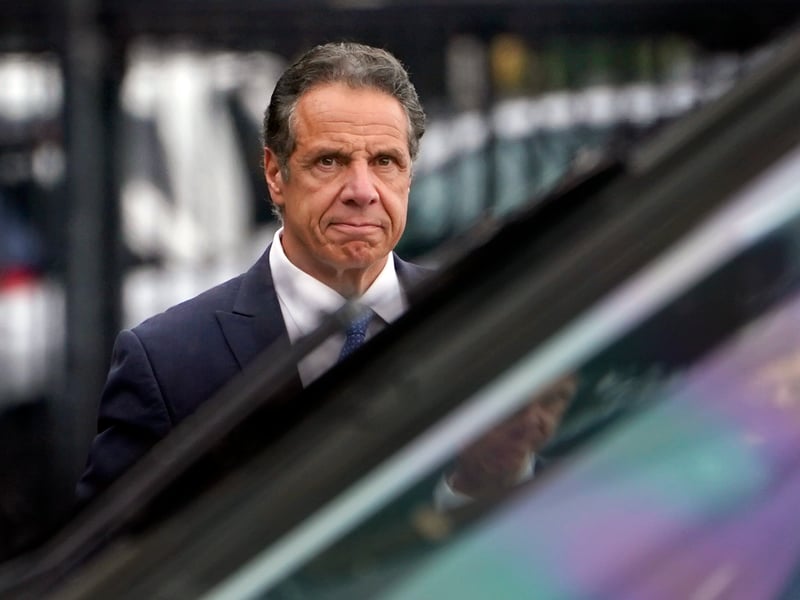
ALBANY (CN) — Former New York Governor Andrew Cuomo on Tuesday lost his bid to dismantle the New York ethics commission probing his $5 million coronavirus book deal. In a split decision, New York’s highest court held the ethics panel to be constitutional.
The Court of Appeals in its 4-3 ruling acknowledged that the Ethics Commission Reform Act of 2022, which created The New York State Commission on Ethics and Lobbying in Government, “goes very near the line of what is constitutionally permissible without crossing it.”
But the state’s separation of powers doctrine is “ flexible and based on a commonsense view of the workings of government, thus allowing for some overlap between the coordinate branches," Associate Judge of the Court of Appeals Jenny Rivera wrote in the majority opinion, echoing the commission’s argument in its appeal brief.
“The court has previously recognized the propriety of independence from the departmental head where necessary to achieve the purposes of a new entity and the commission falls squarely within that precedent,” Rivera wrote. “And, despite what plaintiff contends, the commission’s power to investigate the governor and possibly impose a fine does not interfere with the Legislature’s impeachment power.”
Finding he didn’t carry his burden, the high state court reversed a lower appellate court ruling in Cuomo’s favor.
Richard Azzopardi, a representative for Cuomo, said the former governor intends to file for reconsideration.
“This split ruling is a complete reversal from the unanimous opinion of six judges sitting on two levels of our court system,” Azzopardi wrote on Tuesday afternoon. “But it is disturbing that any judge of New York’s highest court would countenance flagrant violations of the constitution when it conflicts with what is most convenient to the political class.”
Joining Rivera in the majority were Chief Judge Rowan Wilson and Judges Shirley Troutman and Caitlin Halligan.
Criticism that a previous ethics body, the Joint Commission on Public Ethics, wasn’t independent enough led state lawmakers and Governor Kathy Hochul to create the Commission on Ethics and Lobbying in July 2022.
Cuomo urged the state’s top appeals court to affirm that the move unconstitutionally violated “bedrock” separation of powers principles.
His arguments resonated with Court of Appeals Judge Michael J. Garcia, who held in a dissenting opinion that limitations on the commission’s ability to impose fines or discipline people within the legislative branch were part of the reason that the Ethics Commission Reform Act was “a blatant encroachment on the power of another branch”.
“The majority both fails to acknowledge the development of robust executive power in New York and misunderstands the separation of powers implications of a non-unitary executive,” he wrote.
Judges Madeline Singas and Saliann Scarpulla joined Garcia’s dissent. Scarpulla, a First Department judge, sat in place of Court of Appeals Judge Antony Cannataro, who recused himself.
The split ruling returns the case to the appellate court that sided with Cuomo in May 2024 — as did a lower court trial judge the year before. Enforcement of ethics laws is a power that belongs to the executive branch, the trial court said, yet the governor cannot control ethics commission members, force them to explain their actions or remove them for neglecting their duties.
New York Attorney General Letitia James commended Tuesday’s ruling.
“The public deserves to have faith in their elected officials, and that requires a strong, independent ethics watchdog,” she wrote in a statement. “In New York, we value the rule of law, and my office will always work to ensure our laws are defended, no matter who attempts to sidestep or ignore them.”
The 11 members of the ethics watchdog commission are appointed to four-year terms; 5 members are appointed by executive officials and 6 are named by legislators.
Specifically, three members are nominated by the governor; two by the temporary president of the state senate; one by the minority leader of the state senate; two by the speaker of the assembly; one by the minority leader of the assembly; one by the attorney general; and one by the comptroller.
New York legislators said they wanted to restore public trust in government after Cuomo’s 2021 resignation amid a sexual harassment scandal.
Cuomo accrued praise as a public leader throughout the pandemic in 2020, even earning an Emmy award for his daily livestreamed briefings while New York was the national epicenter of the coronavirus.
He published his memoir about his administration’s efforts, “American Crisis: Leadership Lessons from the Covid-19 Pandemic,” in October 2020.
State officials claim Cuomo did not keep a promise not to use any state resources on the book. Cuomo denies those accusations.
He is rumored to be plotting a comeback with a widely speculated run in New York City’s mayoral election this year.
 Follow @jruss_jruss
Subscribe to our free newsletters
Our weekly newsletter Closing Arguments offers the latest about ongoing trials, major litigation and rulings in courthouses around the U.S. and the world, while the monthly Under the Lights dishes the legal dirt from Hollywood, sports, Big Tech and the arts.