
 Search Articles


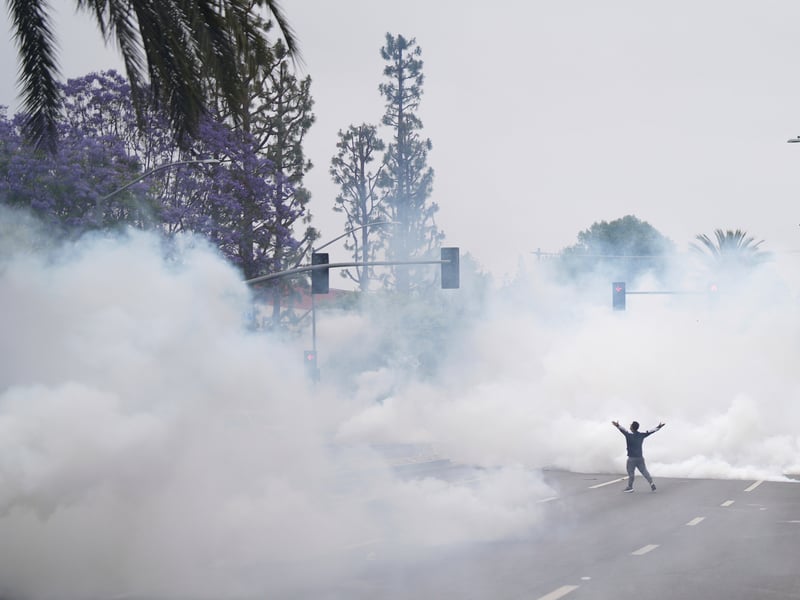
LOS ANGELES (CN) — Two organizations that represent journalists asked a federal judge, on Monday, to issue an injunction ordering the LAPD and the Department of Homeland Security to stop subjecting journalists covering protests to police violence.
The LA Press Club sued the city of Los Angeles in June over police actions during protests against immigration sweeps, and two days later joined the NewsGuild, a union representing journalists, in suing the Department of Homeland Security over the same issue. Their complaints cite journalists injured by law enforcement, including Australian reporter Lauren Tomasi, who was shot in the back with a rubber bullet. Video footage shows an LAPD officer in riot gear turning and aiming a large gun at Tomasi, making the incident appear deliberate. Australian Prime Minister Anthony Albanese called it “horrific.”
In July, U.S. District Judge Hernán Vera issued a temporary restraining order barring LAPD from using less-lethal munitions like rubber bullets or tear gas against journalists who aren’t posing a threat, and from “intentionally assaulting, interfering with, or obstructing any journalist who is gathering, receiving, or processing information.” He also prohibited police from citing, detaining, or arresting reporters in closed areas during protests for failing to disperse.
Weeks later, the press club filed a motion asking the judge to sanction, alleging the city repeatedly violated the order after three journalists were struck with batons by police.
On Monday, ACLU attorney Adrienna Wong, representing the press club, said footage showed LAPD repeatedly firing rubber bullets and tear gas into crowds, some of which included children. She argued the force was unnecessary to disperse protesters and noted there was no evidence any of the shootings had been investigated.
“All this points to it being officially sanctioned conduct,” Wong told the judge.
Assistant City Attorney Gabriel Dermer argued that video footage often tells only one side of the story. For example, he said, other camera angles of the Tomasi shooting showed that Tomasi was not the intended target of the shooting. He also argued that most of the journalists who got hurt were in the middle of a crowd that had turned violent.
“These scenes are chaotic,” Dermer said. “Unfortunately, sometimes, the press get hit because they’re near some individual acting violently.”
Counsel to the Assistant Attorney General Sean Skedzielewski took an even harder line, arguing law enforcement was at times justified in using force against people videotaping them.
“Videotaping can be used for violence in two ways,” Skedzielewski said, adding that the footage could be used to “dox” agents — that is, reveal their identity and address to target them for harassment, and to encourage more protestors to join the fray. And many of the protests, Skedzielewski argued, had become violent, with protestors throwing rocks and projectiles at police. That made the crowd, he said, guilty of “sheltering wrongdoers.”
“Officers are well within their right to defend themselves,” Skedzielewski said. “Warnings were given.”
Vera said he was reluctant, at this point in the case, to issue sanctions, although he was open to revising or tightening the restraining order and extending it to the federal government. Longtime civil rights attorney Carol Sobel, representing the press club, urged the judge to take a hard line, issuing an injunction that was “more specific and more consequential.”
“There has to be consequences, because this goes back decades in this city,” Sobel said.
Vera did not say when he would rule on the matter.
 Follow @hillelaron
Subscribe to our free newsletters
Our weekly newsletter Closing Arguments offers the latest about ongoing trials, major litigation and rulings in courthouses around the U.S. and the world, while the monthly Under the Lights dishes the legal dirt from Hollywood, sports, Big Tech and the arts.