
 Search Articles


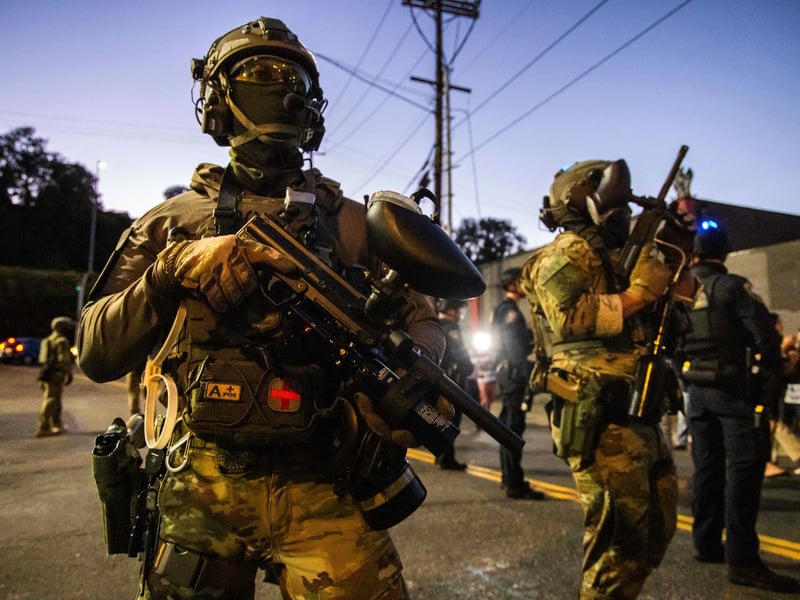
PORTLAND, Ore. (CN) — President Donald Trump’s order federalizing and deploying 200 members of the Oregon National Guard was within his statutory authority, a Ninth Circuit panel ruled Monday, and blocked a lower court’s temporary restraining order.
Trump had federalized troops to protect “war ravaged” Portland and its Immigration and Customs Enforcement facility, the site of ongoing protests.
Trump likely “lawfully exercised his statutory authority” when he authorized federalization of the National Guard, the three- judge panel concluded. The panel featured U.S. Circuit Judges Ryan Nelson and Bridget Bade — both appointed by Donald Trump during his first term — as well as Bill Clinton-appointed U.S. Circuit Judge Susan Graber.
The per curiam order affects the first of two temporary restraining orders issued by U.S. District Judge Karin Immergut in early October. The first order blocked Trump from federalizing and deploying the Oregon National Guard, and the second order blocked him from deploying any National Guard troops.
The panel reasoned that Trump’s authority to federalize the National Guard is statutory rather than constitutional. In this case, the appeals court found it justified by Trump being “unable with regular forces to execute the laws of the United States.”
Within two hours of the panel issuing the order, a Ninth Circuit judge called for a vote on whether the court should rehear the case en banc.
The lower court wrongly “discounted the violent and disruptive events” at the ICE facility occurring over the summer when it issued the temporary restraining order, according to the panel. While the city and state characterized the protests at the ICE facility as mild, the Ninth Circuit pointed to instances where protesters blocked the driveway of the facility in anticipation of shift change or otherwise disrupted operations.
“Rather than reviewing the president’s determination with great deference, the district court substituted its own determination of the relevant facts and circumstances,” the panel wrote.
While the city and state characterized the protests at the ICE facility as mild, the Ninth Circuit pointed to instances where protesters blocked the driveway of the facility in anticipation of shift change or otherwise disrupted operations.
“The undisputed facts show that protesters damaged a federal building, leading to its closure for over three weeks, attempted to burn the building down, placed chains on the doors, attempted to breach the front door of the building and broke the front glass door, threw objects at the building, including rocks, sticks, and a mortar, and launched M80 fireworks at federal officers, assaulted federal officers, shined lasers at officers’ eyes, and doxed federal officers,” the panel wrote.
The panel also found the lower court erred by placing too much weight on Trump’s social media posts. The lower court concluded that Trump’s description of Portland as “war ravaged” ignored the facts on the ground, but the Ninth Circuit found that other facts provide a reasonable basis to support the statutory requirements “even if the president may exaggerate the extent of the problem on social media.”
While the second temporary restraining order blocking the deployment of the National Guard is not on appeal before the Ninth Circuit, the panel noted that it is based on the same legal reasoning as the first one.
“Defendants are thus correct that the first TRO and the second TRO rise or fall together on the merits of the issues raised in this motion for a stay pending appeal,” the panel wrote.
In a concurrence, Nelson called the federalization and deployment of the National Guard as a “measured response” intended to restore order to the federal building.
“District courts must not micromanage the president’s use of statutory powers delegated to him under the militia clause,” Nelson wrote.
The White House celebrated the order, saying it affirmed that the lower court’s ruling was unlawful and incorrect.
“As we have always maintained, President Trump is exercising his lawful authority to protect federal assets and personnel following violent riots that local leaders have refused to address,” White House spokesperson Abigail Jackson said in a statement.
Oregon Attorney General Dan Rayfield ripped the order.
“Today’s ruling, if allowed to stand, would give the president unilateral power to put Oregon soldiers on our streets with almost no justification,” Rayfield said in a statement. “We are on a dangerous path in America.”
He referenced the dissent from Graber, who urged the Ninth Circuit to “act swiftly to vacate the majority’s order before the illegal deployment of troops under false pretenses can occur.”
Graber said the majority’s order “abdicates our judicial responsibility” and allowed the president to invoke emergency authority in a situation that didn’t warrant such authority.
“Given Portland protesters’ well-known penchant for wearing chicken suits, inflatable frog costumes, or nothing at all when expressing their disagreement with the methods employed by ICE, observers may be tempted to view the majority’s ruling, which accepts the government’s characterization of Portland as a war zone, as merely absurd,” Graber wrote, referencing the increase in costumes at the frontlines of the protests. “But today’s decision is not merely absurd. It erodes core constitutional principles, including sovereign states’ control over their states’ militias and the people’s First Amendment rights to assemble and to object to the government’s policies and actions.”
Deploying troops in Portland will likely aggravate the situation at the ICE building, harm neighboring businesses and deprive the state of resources to respond quickly to emergencies, Graber wrote.
“Above all, I ask those who are watching this case unfold to retain faith in our judicial system for just a little longer,” she wrote.
Subscribe to our free newsletters
Our weekly newsletter Closing Arguments offers the latest about ongoing trials, major litigation and rulings in courthouses around the U.S. and the world, while the monthly Under the Lights dishes the legal dirt from Hollywood, sports, Big Tech and the arts.