
 Search Articles


RALEIGH, N.C. (CN) — North Carolina lawmakers reached a compromise on funding Wednesday, successfully allocating $528 million in long-sought hurricane relief after weeks of discussion.
Legislators have emphasized that relief funding was their first priority this session, but both chambers have had different outlooks on what needs to be done immediately and House Bill 47 stalled to a halt in the House last week after it was sent back from the Senate. The two chambers came to an agreement earlier this week, which the House passed Tuesday.
The bill passed the Senate unanimously Wednesday afternoon, and was sent to Governor Josh Stein, who has said that he will sign it into law, despite pushing for more support.
“This is just the next round in funding,” said Speaker of the House Destin Hall. “And after we pass this one, I know we in the House intend to start on the next round.”
Lawmakers have elected to tackle recovery with a number of bills, rather than passing large, sweeping measures, with Hall pointing out that bulk funding hasn’t been successful in helping the eastern part of the state recover from hurricanes in the past, and that the Republican majority wants to work towards quicker and more thorough rebuilding through more targeted bills. This measure is their fourth in the process.
The state has spent over $1.4 billion on relief funding, with this measure funneling$200 million into a Helene crop loss and farm restoration program, $100 million in repairing private roads and bridges and $55 million for small business grants.
Another $217 million goes to “close out” home rebuilding operations in eastern North Carolina — left over from Hurricanes Florence in 2018 and Matthew in 2016, which Hall blames on mismanagement under former Governor Roy Cooper’s administration.
The $217 million had originally been introduced as its own bill, dubbed the C.O.O.P.E.R Accountability Act as a snub to the former governor — who Republican leaders have blamed for unresolved recovery efforts — before it was folded into relief funds as a part of a compromise between the chambers.
“You’ve got people living in hotels in eastern North Carolina 10 years after the hurricane hit in 2016,” Hall said, pointing to Hurricane Matthew. Republican leadership has emphasized that they don’t want to make the same mistakes again, while Democrats have pushed for more to be done, rapidly.
Hall said the House plans to address additional priorities as they become aware of them, and that lawmakers are working to identify on-the-ground needs as they prepare for future funding. Lawmakers have yet to specify if they plan to draft an additional stand-alone bill, or if additional recovery money will be bundled into the state budget.
“At the end of the day, what we’ve got to do is get folks back in their homes as quickly as possible and whatever it takes to do that, we’re going to do,” Hall said.
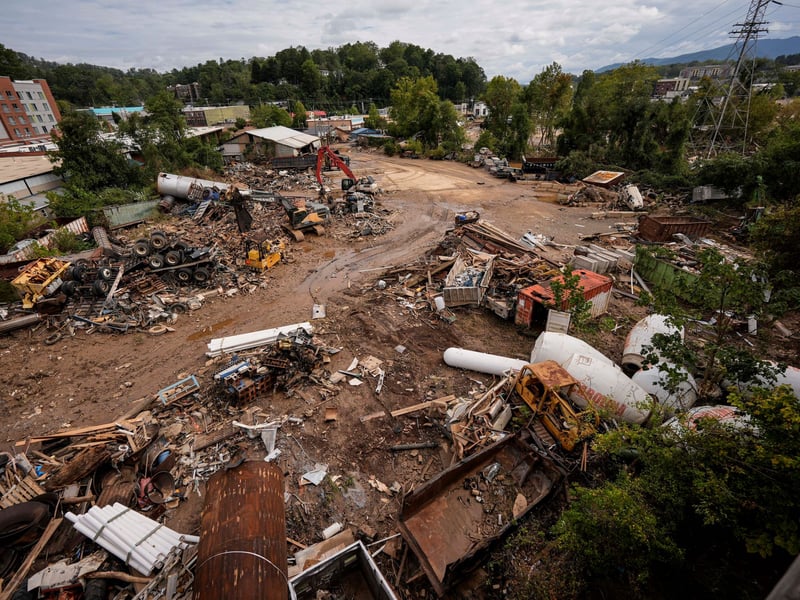
Recovery efforts have been an ongoing process as lawmakers have slowly moved money to support western North Carolina, and the measure also supports debris removal and grants to encourage tourists — a major industry in the area — to return.
“This bill marks another important step forward for the people of Western North Carolina,” Representative John Bell, the primary bill sponsor, said. “It allocates essential funding for home construction, farmer support, small business relief and educational assistance. Additionally, it ensures that hurricane victims in Eastern North Carolina can return to their homes after years of neglect under former Governor Cooper’s administration.”
Stein called the amount “inadequate” and said that it was “just a start.”
“We are looking at $60 billion in damages,” the current governor said. “By a factor of three, the most damaging storm in North Carolina history.”
Stein said he will submit another relief proposal to the legislature in the coming weeks, and that he intends to keep pushing Congress for additional federal funding.
 Follow @SKHaulenbeek
 Follow @shaulenbeek.bsky.social
Subscribe to our free newsletters
Our weekly newsletter Closing Arguments offers the latest about ongoing trials, major litigation and rulings in courthouses around the U.S. and the world, while the monthly Under the Lights dishes the legal dirt from Hollywood, sports, Big Tech and the arts.