
 Search Articles


RALEIGH, N.C. (CN) — A pair of bills supporting shared goals with the Trump administration began moving through the North Carolina legislature Wednesday.
The Senate Judiciary committee heard Wednesday afternoon two bills proposed by Republican North Carolina lawmakers that focused on increasing compliance with U.S. Immigration and Customs Enforcement, eliminating sanctuary cities and schools and limiting the abilities of the Democratic state Attorney General Jeff Jackson.
Jackson — who won the race over Republican contender Dan Bishop, known for his controversial “bathroom bill,” in November — has already joined other Democratic attorneys general in filing suit over several of President Donald Trump’s executive orders, including birthright citizenship, the funding freeze, cuts to medical research and Department of Government Efficiency’s access to Treasury Department payment systems.
Republicans approved in committee a bill that would prevent Jackson and future state attorneys general from participating in litigation — either federally or in other states — that would invalidate any executive order by the president. It was further amended Wednesday to prevent Jackson from filing an amicus curiae brief or acting as any other participant in these legal challenges.
State Senator Dan Blue, a Democrat, raised the possibility that the potential change to Jackson’s position could pose a First Amendment issue, as Jackson may be unable to participate as an individual, outside of his jurisdiction as attorney general, which Republican senators largely dismissed.
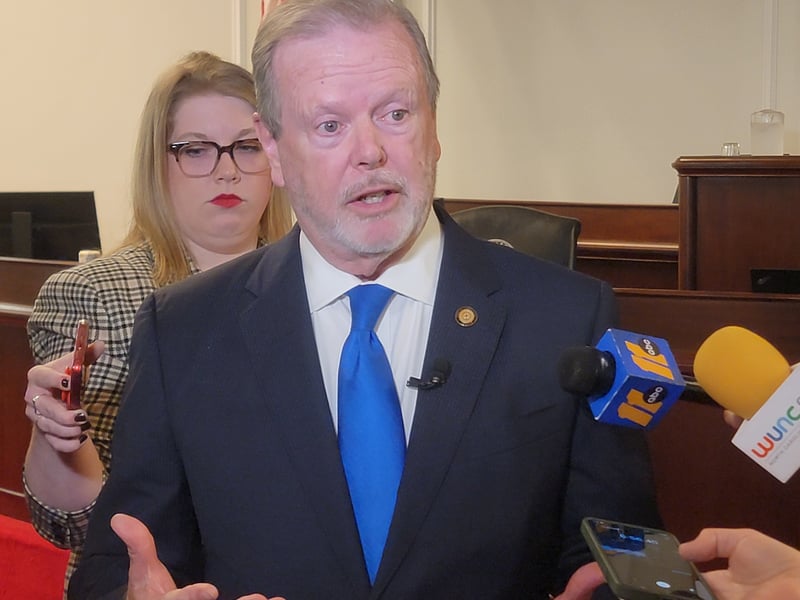
“We want the attorney general of North Carolina handling business for the people of North Carolina in the context of what you would expect the state’s attorney to do,” said Senate President Pro Tempore Phil Berger. “He was spending a lot of time going off with other Democratic attorneys general, and filing lawsuits in various jurisdictions around the country. We want him working for the people of North Carolina here, as opposed to going off on some political quest.”
“I think we’ve gone over the last several decades of giving our council of state seats too much authority. All their authority is given to them by this General Assembly, and we need to control that,” said Senator Bobby Hanig, one of the bill sponsors. “One person shouldn’t have ultimate power, or too much power.”
Republican Senator Amy Galey described the bill as moving to prevent the attorney general from acting as a tax-payer funded “policy weapon,” while Democratic Senator Mujtaba Mohammed said it was tying the hands of an important member of the council of state.
“He is the lawyer for the people. He is the lawyer who has been elected by the people of North Carolina to protect them, to protect them by enforcing North Carolina’s constitutional laws, but also a lawyer who is charged with protecting North Carolina’s constitutional rights,” Liz Barber, director of policy and advocacy for the ACLU of North Carolina, said in a public comment during the session. “This is certainly not a policy weapon.”
Lawmakers also discussed a measure that would require varying state law enforcement agencies to allow designated officers to perform immigration law enforcement functions and require the departments to develop policies to confirm the citizenship status of people in custody.
The bill would direct the agencies to cooperate with ICE “to the fullest extent allowed by law,” and instructs agencies to notify ICE when they determine they’ve detained someone who is not a lawful resident. It also requires the state to audit public benefits programs, such as housing assistance, child care subsidy programs and refugee assistance programs to ensure that non-citizens aren’t receiving state benefits.
Democratic Senator Sophia Chitlik pointed out that many undocumented immigrants pay into benefit programs that they are ineligible to access, and said the measure may deter mixed status families from applying for benefits that their children are eligible for.
The bill also releases sanctuary cities from government immunity from civil liability if an undocumented immigrant commits a crime within its limits, and requires University of North Carolina colleges to comply with members of law enforcement gathering immigration and citizenship status.
The measure follows House Bill 10, which the legislature passed last session to require a handful of hold-out sheriffs to detain non-citizens charged with a crime for 48 hours and contact ICE. The sheriff’s department in Charlotte has not been calling ICE ahead of the release of these detainees, sparking additional discussions over revising the statute.
“The one thing that I think that is really not controversial for the overwhelming number of people in this state, in this country, is that if you’re here illegally, and you’re committing crimes in our state, then you should be deported,” said Speaker of the House Destin Hall. “And any policy that we can pass at the state level that assists the federal government in that role, I think that we should do that.”
The Senate is expected to fast-track the immigration measure and take it up for votes next week, along with a measure for relieffor hurricane-hit areas.
 Follow @SKHaulenbeek
 Follow @shaulenbeek.bsky.social
Subscribe to our free newsletters
Our weekly newsletter Closing Arguments offers the latest about ongoing trials, major litigation and rulings in courthouses around the U.S. and the world, while the monthly Under the Lights dishes the legal dirt from Hollywood, sports, Big Tech and the arts.