Search Articles



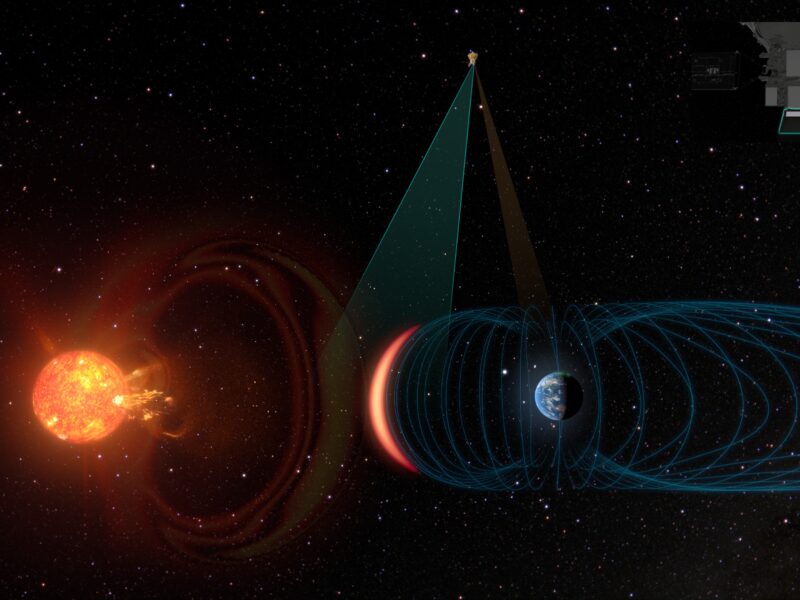
(CN) — Europe and China on Tuesday jointly launched a spacecraft into orbit that will study how the Earth’s magnetic field responds to the sun’s bursts of energy and provide scientists with key insights into space storms.
However, Tuesday’s launch of the Smile spacecraft also likely marked both the first and last major collaboration in space for the foreseeable future between Europe and China amid rising global tensions and geopolitical rivalry.
The Smile satellite reached orbit aboard a Vega-C rocket that shot off Tuesday morning from Europe’s Spaceport in French Guiana in South America.
The mission was developed by the European Space Agency and the Chinese Academy of Sciences.
Over the next three years, the scientific spacecraft will use four instruments — including an X-ray camera and an ultraviolet camera — to study the interaction between solar wind and the Earth’s magnetosphere — the magnetic field that acts as a protective bubble against the bursts of radiation and charged particles streaming from the sun.
The research will give scientists their first global X-ray imagery of the dynamics taking place at the boundary between Earth and the sun. Until now, researchers have relied on “point measurements,” or snapshots, to understand this process.
“Previously, we could only see the trees, not the forest,” said Wang Chi, a lead researcher on the Smile mission at the Chinese Academy of Sciences, as reported by the People’s Daily, a Chinese state newspaper.
With this imagery in hand, researchers hope to better understand solar storms, geomagnetic storms and the science of space weather. The data will be useful in protecting satellites, power grids and communication systems from solar storms.
“We are about to witness something we’ve never seen before — Earth’s invisible armor in action,” said Josef Aschbacher, the director general of ESA, in a statement.

Smile is an acronym for “Solar wind Magnetosphere Ionosphere Link Explorer.”
Mapping the solar wind hitting the Earth’s magnetic field will also help astronomers studying phenomena in distant galaxies, such as black holes, supernovas and hot gases.
That’s because astronomers looking far into space have long needed to develop complex mathematical models to subtract the X-rays sparked by solar wind in the solar system to trace X-rays emitted in distant galaxies.
Jonathan McDowell, an astronomer and space expert at Durham University in England, called the Smile mission “innovative” for studying X-rays sparked by solar wind hitting the Earth’s thin cloud of hydrogen gas — part of the process known as the “solar wind charge exchange.”
“The X-ray instrument will study ‘solar wind charge exchange,’ a source of X-rays from the solar system which has long annoyed those of us trying to study X-rays from distant galaxies,” he said in an email.
He said this dynamic has “never had a mission aimed at studying it for its own sake rather than something to correct out.”
The Smile mission goes back to 2015, when an era of collaboration between Europe and China was still expanding in space and other fields. However, that era ended when U.S. President Donald Trump entered the White House in 2017 and installed an extremely hawkish attitude toward China.
Europe, often grudgingly, has gone along with the U.S. and placed restrictions on Chinese technology over security concerns. Wariness of engaging with China has extended to space programs.
In the early 2000s, Europe and China saw great potential benefits in collaboration, but the partnership has gone off track due to mistrust and diverging strategies.
In 2003, China and ESA joined forces in the Double Star mission, a forerunner to Smile. The mission consisted of two small satellites designed to study Earth’s magnetic field and its interaction with solar wind.
The Smile mission evolved from Double Star and represented a 50/50 split between the ESA and the Chinese Academy of Sciences — with shared costs, technology and science.
But this window of cooperation is likely closing.
The relationship actually began to sour with the Galileo navigation project in 2007, when China complained it was marginalized from key decision-making roles. That pushed Beijing to accelerate its independent BeiDou system.
Meanwhile, a European embargo on Russian cooperation following Moscow’s invasion of Ukraine has blocked ESA from joining China’s International Lunar Research Station, where Russia is a partner. Instead, ESA has committed to NASA’s Artemis Accords, from which China is excluded.
Future cooperation, therefore, seems likely to be limited to data sharing or small instruments. For example, in 2024, the ESA sent its first experiment on the lunar surface with China’s Chang’e-6 mission.
“Today, ESA’s cooperation with China is focused primarily on Earth science and space science,” an ESA spokesperson said in a statement.
ESA said there were no plans for collaboration with China on new missions.
Courthouse News reporter Cain Burdeau is based in the European Union.
 Follow @cainburdeau
Subscribe to our free newsletters
Our weekly newsletter Closing Arguments offers the latest about ongoing trials, major litigation and rulings in courthouses around the U.S. and the world, while the monthly Under the Lights dishes the legal dirt from Hollywood, sports, Big Tech and the arts.