
 Search Articles


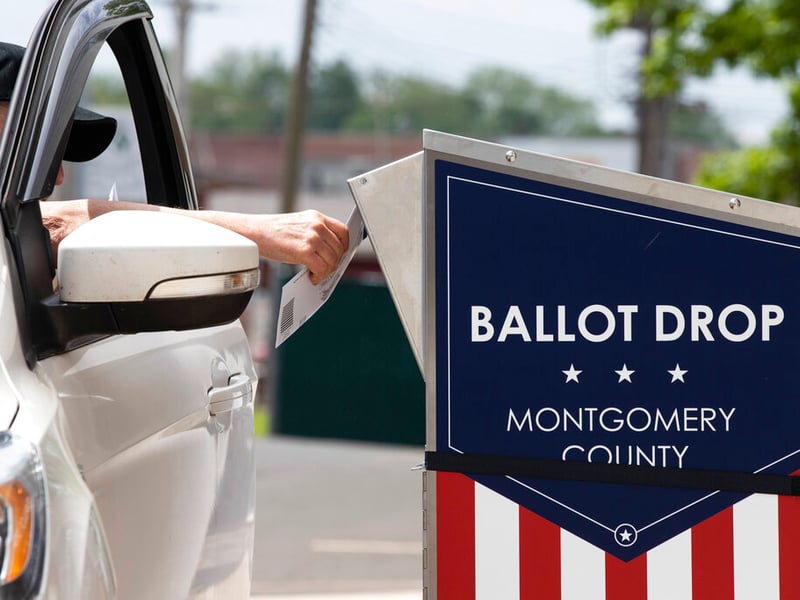
PHILADELPHIA (CN) — Pennsylvania cannot continue to throw out mail-in ballots containing incorrect or missing dates, a Third Circuit panel ruled Tuesday.
“This ruling is a decisive victory for voting rights and democratic participation in Pennsylvania,” said Uzoma Nkwonta, an attorney for plaintiff Bette Eakin. “The court recognized what we’ve long argued: that discarding otherwise valid ballots over trivial errors that have nothing to do with the voter’s eligibility is a violation of voters’ fundamental constitutional rights.”
In November 2022, Eakin — a resident of Erie County, Pennsylvania, who is blind and physically unable to cast an in-person ballot — had her 2022 general election mail-in ballot rejected after she failed to write a date on her return envelope.
Eakin — joined by multiple Democratic Party committees and the American Federation of Teachers — promptly sued the election boards of all 67 Pennsylvania counties, arguing in the U.S. District Court for the District of Western Pennsylvania that the state’s refusal to count ballots with misdated and undated envelopes violated Eakin’s constitutional right to vote.
Counsel for the Republican National Committee and Berks County, Pennsylvania, argued in federal court that the date requirement is necessary to further state interests, including promoting election efficiency and preventing voter fraud.
However, in March, the court ruled in favor of Eakin. While the date requirement imposed only a minimal burden on Pennsylvanians’ right to vote, U.S. District Judge Susan Paradise Baxter determined that the RNC and Berks County failed to present any evidence that the requirement actually furthered any of their presented state interests. Thus, the first-term Donald Trump appointee ruled that the requirement’s imposed burden outweighed its value to the state.
The RNC quickly appealed to the Third Circuit, but on Tuesday, a three-judge panel agreed with the lower court’s ruling.
“While the commonwealth has raised legitimate interests related to voting, we see only tangential links, at best, between these interests and the date requirement that Pennsylvania imposes on mail-in voters,” wrote senior U.S. Circuit Judge D. Brooks Smith, a George W. Bush appointee, in his opinion. “The date requirement does not play a role in election administration, nor does it contribute an added measure of solemnity beyond that created by a signature. And only in the exceedingly rare circumstance does it contribute to the prosecution of voter fraud.”
U.S. Circuit Judges Patty Shwartz, a Barack Obama appointee, and Arianna J. Freeman, a Joe Biden appointee, ruled alongside Smith.
The appeals court’s ruling comes approximately a week after President Donald Trump announced on his social media platform that he plans to “lead a movement” to eliminate mail-in ballots ahead of the 2026 midterm elections.
In his Aug. 18 post, Trump falsely claimed that the U.S. is the only nation remaining to allow mail-in voting and made unfounded claims of “massive voter fraud” via mail-in ballots — a claim Trump has repeated since the 2020 general election, when he falsely asserted that the presidential election was stolen from him.
Notably, Trump also falsely asserted in his post that the states are beholden to him with regards to how federal elections are conducted.
“Remember, the States are merely an ‘agent’ for the Federal Government in counting and tabulating the votes,” Trump wrote. “They must do what the Federal Government, as represented by the President of the United States, tells them, FOR THE GOOD OF OUR COUNTRY, to do.”
In reality, the U.S. Constitution grants administration of elections to state legislatures, allowing Congress to alter electoral regulations in rare instances. Even then, Congress’ powers only extend to state administration of presidential and congressional elections — only states can dictate how their own state and municipal elections are run.
The Constitution does not prescribe any electoral administrative powers to the executive branch, including the president.
Counsel for the Republican National Committee could not be immediately reached for comment.
 Follow @JacksonHeals
Subscribe to our free newsletters
Our weekly newsletter Closing Arguments offers the latest about ongoing trials, major litigation and rulings in courthouses around the U.S. and the world, while the monthly Under the Lights dishes the legal dirt from Hollywood, sports, Big Tech and the arts.