Search Articles


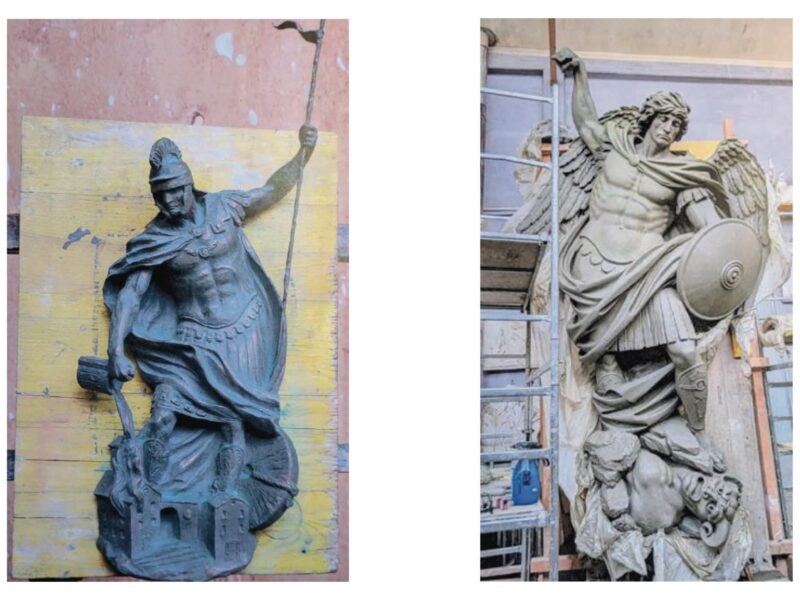
BOSTON (CN) — The Massachusetts Supreme Court turned an argument Wednesday over whether a city’s public safety building can feature statues of Florian and Michael — Catholic saints who are also symbols of firefighters and police — into a colorful philosophical debate over the role of religion in civic life.
“There’s not a hermetically sealed separation between church and state,” said Justice Scott Kafker. “We can’t allow more hostility to religion than the U.S. Supreme Court would tolerate, and they have a very low tolerance.”
But Justice Gabrielle Wolohojian thought differently. “The public safety headquarters will provide necessary public services, the citizens of Quincy will need to have access, and in that context, why doesn’t it heighten our concern about government speech embodied in the two statues?” she demanded.
When the Boston suburb of Quincy — the birthplace of presidents John Adams and John Quincy Adams, as well as John Hancock — built a new public safety building, it commissioned statues of Florian, an ancient Roman soldier who pioneered firefighting brigades, and the Archangel Michael, associated with defense against evil. The two are religious figures but are also internationally recognized as symbols of public safety.
A group of citizens sued, claiming the statues violated a state constitutional provision similar to the establishment clause of the First Amendment. A lower court granted the citizens a preliminary injunction, and the city appealed.
The case drew amicus briefs from the National Fraternal Order of Police, the National Association of Police Organizations, the International Association of Fire Fighters, the American Legion, and religious groups including Catholics, Methodists, Jews, Muslims, Hindus, Orthodox Christians and Unitarians.
The city’s lawyer, Joseph Davis of the Becket firm in Washington, argued that numerous fire departments wore the Florian cross and named three other cities with similar statues. But Wolohojian was having none of it, forcing Davis to admit there are no similar statues in the Bay State.
“So there are none in Massachusetts and you’ve come up with three out of the probably hundreds of thousands of buildings in the U.S.,” she scoffed.
Davis insisted the figures weren’t solely religious and over time had acquired a broader meaning. “But can you understand that significance without reference to their hagiography?” Wolohojian pressed.
Kafker, on the other hand, cited a 1979 case in which the Massachusetts court approved the state’s paying chaplains to give invocations. “Why does this cross the line when a Catholic chaplain in the Legislature didn’t cross the line?” he wondered.
Florian and Michael’s dual roles as saints and public safety representatives made the case difficult.
“If Quincy could show that Florian and Michael are mascots in a sports-team type of way, just an encouraging symbol, like Gritty, are you saying that the well is poisoned because they came from a religious tradition?” Justice Elizabeth Dewar asked the plaintiffs’ lawyer, Jessie Rossman of the ACLU, citing the Philadelphia Flyers’ mascot.
Rossman didn’t answer and said she was merely asking the court to approve the injunction on the current record.
When Davis talked about analyzing history and constitutional purpose, Justice Frank Gaziano said that approach “frightens me” because it resembles the U.S. Supreme Court’s Bruen decision — which requires courts to analyze the Second Amendment by studying the history of colonial-era gun regulation, and which many judges have struggled to make sense of.
Gaziano’s approach to secular vs. religious purpose was much more down-to-earth: “A citizen is driving down the road and he sees this big statue of an angel smiting a demon and someone has to explain, ‘Oh, that’s a symbol of the police.’ You have to crane your neck to see that St. Florian is holding a pitcher of water. Isn’t that kind of niche? I’m thinking about a person who’s driving to Roxie’s to get their bargain meat.”
Davis argued that Florian and Michael aren’t specifically Catholic because they are significant to Jews, Muslims and others. However, “adding more religions doesn’t make them more secular,” Wolohojian retorted.
But Justice Dalila Argaez Wendlandt asked, “Why not?” She said the Constitution prohibits favoring one religion over another, and “multiple sects seem relevant.”
“You’re still elevating religion,” Rossman said. She added that the designs of the Quincy statues “reflect the specific Catholic iconography” and the city could have chosen to honor heroic present-day emergency responders.
“So if we had St. Michael, St. Florian, and some real other people, would that pass constitutional muster?” Wendlandt asked.
Davis noted that the courthouse where the argument took place itself contained a statue of Moses. But Wolohojian observed that Moses was one of 16 law-related figures, and “here there are only two statues.”
Justice Serge Georges noted that the Quincy public safety staff supported the statues. “There might be Catholics, Jews, agnostics and atheists on the Quincy staff. But they all find it to be professional,” he said.
Georges suggested the views of the police and firefighters themselves might carry more weight than “the guy who’s going to Roxie’s because brisket is on sale. Are we going to turn the Constitution into a heckler’s veto?”
Subscribe to our free newsletters
Our weekly newsletter Closing Arguments offers the latest about ongoing trials, major litigation and rulings in courthouses around the U.S. and the world, while the monthly Under the Lights dishes the legal dirt from Hollywood, sports, Big Tech and the arts.