
 Search Articles


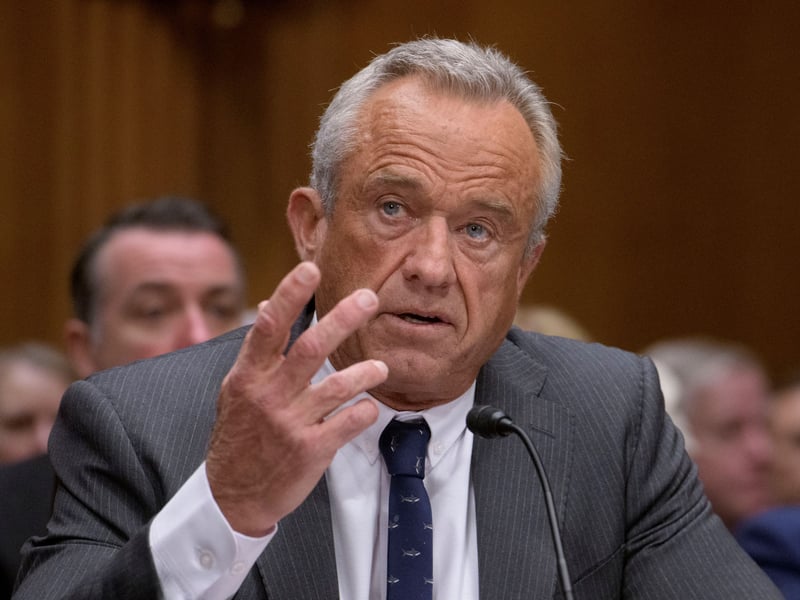
WASHINGTON (CN) — It was a tense scene in the Senate Finance Committee on Thursday morning, as Health and Human Services Secretary Robert F. Kennedy, Jr. faced lawmakers’ wrath over his recent move to change the government’s vaccine policy.
Kennedy, who has long been publicly skeptical about the safety of vaccines, last week directed the U.S. Food and Drug Administration to restrict who is eligible to receive Covid-19 immunization. It was a step that departed from his “pro-vaccine” commitment to lawmakers and resulted in a mass exodus of top leadership from the Centers for Disease Control and Prevention — including the agency’s new director.
As he testified before the Finance Committee Thursday, the Health and Human Services secretary largely kept his remarks focused on President Donald Trump’s so-called “Make America Healthy Again” campaign and efforts to cut what the White House sees as waste and abuse in federal health care infrastructure.
“Under President Trump’s leadership, we at HHS are enacting a once-in-a-generation shift from a sick care system to a true health care system that tackles the root causes of chronic disease,” he told senators.
But committee members on both sides of the aisle were eager to hold Kennedy’s feet to the fire on the vaccine controversy.
Oregon Senator Ron Wyden, the top Democrat on the Finance Committee, argued that the secretary’s “primary interest” was to eliminate vaccine access.
“During his confirmation process, he claimed to be pro-safety and pro-science, but his actions reveal a steadfast commitment to elevating junk science and fringe conspiracies,” Wyden said. “Robert Kennedy has elevated conspiracy theorists, crackpots and grifters to make life-or-death decisions about the health care of the American people.”
And even before Kennedy began his opening remarks, partisan sparks were already flying. Wyden accused Kennedy of lying to the Senate, pointing out that in written questions to lawmakers Trump’s health care czar said that he would “do nothing as HHS secretary that makes it difficult to or discourages people from taking vaccines.”
The Oregon Democrat demanded that the Finance Committee formally swear in Kennedy as a witness, an action not typically taken with administration officials. But Idaho Senator Mike Crapo, the panel’s chairman, blocked the move, saying that he disagreed with Wyden’s “characterization of the facts.”
Wyden called on Kennedy to step down or be fired and criticized his Republican colleagues for what he saw as a lack of concern about the secretary’s leadership.
“What line must Robert Kennedy cross before some of you will also join in this alarm?” he said.
Kennedy, addressing the change in vaccine guidelines and what he called a staffing “shake-up” at CDC, said that the agency “failed their responsibly miserably” during the Covid-19 pandemic with what he called “disastrous and nonsensical” mitigation policies which affected small businesses and schools and damaged civil liberties.
The new restrictions on vaccine access were “absolutely necessary adjustments to restore the agency to its role as the world’s gold standard public health agency with the central mission of protecting Americans from infectious disease,” the secretary said.
“That’s why we need new blood at CDC,” Kennedy told the Finance Committee. “That’s also why it’s imperative that we remove officials with conflicts of interest and catastrophically bad judgment and political agendas.”
The Health and Human Services Department announced last week that Susan Monarez, the White House-appointed CDC director, had departed from the agency. Monarez, who had served in her role for less than a month, reportedly refused to commit to the vaccine policy changes directed by Kennedy. Attorneys for the ousted CDC director later said that she would not leave her position and argued that she had been targeted for refusing to “rubber-stamp” the administration’s directives.
In an op-ed published Thursday in the Wall Street Journal, Monarez said that she had been ordered by the secretary to “pre-approve” the recommendations of a vaccine advisory panel that was filled with people she characterized as vaccine skeptics.
But Kennedy told lawmakers that the embattled CDC director was lying.
“I did not say that,” he told Wyden. “I never had a private meeting with her … there were other witnesses to every meeting that we had, and all of those witnesses will say I never said that.”
Monarez’s attorneys responded to Kennedy’s accusations in a statement Thursday afternoon, calling them false and “at times, patently ridiculous.”
“Dr. Monarez stands by what she said in her op-ed in The Wall Street Journal , would repeat it all under oath and continues to support the vision she outlined at her confirmation hearing that science will control her decisions,” wrote attorneys Mark Zaid and Abbe Lowell.
Following Monarez’s reported departure from the CDC last week, several other top officials resigned from the agency — including Demetre Daskalakis, director of the CDC’s National Center for Immunization and Respiratory Disease, who publicly accused Kennedy and the Trump administration of threatening public health readiness.
As he testified Thursday, Kennedy took on an incredulous and often combative disposition as he sparred with Democrats on the Finance Committee, scoffing at their questions and repeatedly interjecting while they spoke.
The Health and Human Services secretary clashed fiercely with Wyden over the agency’s vaccine agenda, which the Oregon senator called “fundamentally cruel.” Kennedy offered a sharp rebuke, accusing the senator of doing “nothing” in his position to address what he’s said is a precipitous rise in chronic disease.
Washington Senator Maria Cantwell called Kennedy a “charlatan,” accusing him of spreading conspiracy theories. Kennedy fired back that the Democrat was “so wrong on the facts.”
During his confirmation process, Kennedy came under scrutiny by both Democrats and Republicans for his long history of vaccine skepticism. The then-nominee told the Finance Committee during a January hearing that he was not “anti-vaccine” and said that he would “support the vaccine program.”
Kennedy’s confirmation largely hinged on Louisiana Senator Bill Cassidy, a Republican lawmaker and physician who was concerned about the nominee’s opinions on vaccines. But after meeting with Kennedy, Cassidy decided to support him.
During Thursday’s hearing, the Louisiana Republican grilled Kennedy on his approach to government vaccine programs during his time as head of the Health and Human Services Department, such as his move to cancel hundreds of millions of dollars in mRNA vaccine contracts. And he expressed concerns about changes on the vaccine advisory panel, pointing out that some of the commission’s members were “paid witnesses” for people who have sued vaccinemakers.
“That seems like a conflict of interest,” he told Kennedy. But the secretary disagreed.
“It may be a bias, and that bias — if disclosed — is okay,” he told Cassidy.
The Louisiana senator ended his remarks by reading out an email from a friend and fellow physician who worried that there was “no firm guidance” about who can receive a Covid-19 vaccine under the recently altered guidelines.
“You told Senator Wyden at the outset that you didn’t want to take vaccines away from people,” Cassidy said. “I would say, effectively, we’re denying people vaccines.”
As the senator relinquished his time, Kennedy offered one last retort: “You’re wrong."
 Follow @BenjaminSWeiss
Subscribe to our free newsletters
Our weekly newsletter Closing Arguments offers the latest about ongoing trials, major litigation and rulings in courthouses around the U.S. and the world, while the monthly Under the Lights dishes the legal dirt from Hollywood, sports, Big Tech and the arts.