
 Search Articles


(CN) — Families of Armenians killed in a 2008 post-election crackdown finally won recognition at the European Court of Human Rights on Thursday, which found their relatives died in a botched police operation and that the state never delivered a real investigation.
In a case tied to one of Armenia’s darkest political moments, the Strasbourg-based court found seven of the nine civilians killed in the March 2008 unrest died because police used force that was not “absolutely necessary.” The judges slammed the operation as “badly planned and executed,” pointing to the “improper use of crowd-control weapons and the indiscriminate and disproportional use of lethal force.”
The court also found officials fell short in investigating the killings, noting that the lack of an effective inquiry has left families without clear answers for over 17 years.
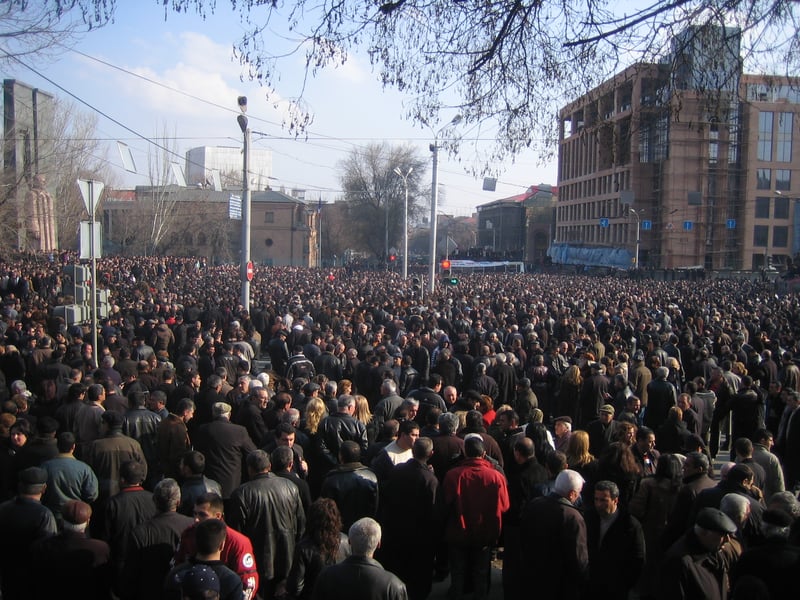
The unrest began after Armenia’s February 2008 presidential vote, where outgoing leader Robert Kocharyan’s ally, Prime Minister Serzh Sargsyan, was declared the winner. His rival, former president Levon Ter-Petrosyan, cried foul, calling the result rigged and urging supporters to rally in Yerevan’s Freedom Square.
For many Armenians, the anger ran deeper than one election: Sargsyan’s victory was seen as a handover of power inside the same ruling circle that had dominated the country since independence, and Ter-Petrosyan’s camp tapped into frustration over corruption, inequality and the sense that democratic change was being smothered.
In the days that followed, crowds camped out in tents, waving banners and demanding change. On March 1, police swept in at dawn. According to the applicants in the case, hundreds of officers “without prior warnings or orders to disperse, had brutally attacked the several hundred demonstrators camped at the square and started beating them with rubber batons.”
The crackdown sent protesters fleeing through Yerevan, but the movement didn’t end there. Many regrouped by the Myasnikyan monument, drawing thousands as the day wore on. By nightfall, makeshift barricades of trolleybuses and cars lined the streets, with chants of “Levon, Levon!” ringing out across the city.
Authorities declared a state of emergency that night. When it was over, eight civilians and two security force members were dead, and more than 200 people had been injured.
In its ruling, the court lays out in stark detail how the violence turned deadly for nine people whose families later went to Strasbourg. Armen Farmanyan, 33, collapsed on Paronyan Street after a tear gas canister shattered inside his skull. Forensic experts traced the fragments to a military-grade grenade designed to be fired from a KS-23 carbine. Tigran Khachatryan, just 23, died from massive head injuries caused by a similar device. And 28-year-old Gor Kloyan was hit in the groin by a gas canister that severed his femoral artery, a wound he could not survive.
Two of the victims initially survived but never recovered. Samvel Harutyunyan, 28, had devastating head injuries from a blunt blow. Tigran Abgaryan, a 19-year-old conscript, was shot in the neck and survived for weeks on life support before dying.
In the end, judges held Armenia responsible for seven deaths. Another case lacked enough proof to assign blame, and in the last the evidence left too much doubt about whether police bullets caused the fatal wound.
What tipped the balance was that the victims were killed during a police operation, carried out with state weapons and under state command. For the court, that made the responsibility clear. The bigger picture was also unmistakable: the violence stemmed from a bungled, poorly executed crackdown. The rights court stressed that lethal force should be a last resort — never the routine way to break up a protest.
The court also found Armenia dragged its feet on investigating. Judges pointed to long delays, missing evidence and a process that lacked real transparency. Families were recognized as victims months late and shut out from key case files. In the court’s words, the authorities “failed to conduct an effective investigation into the circumstances of the deaths of the applicants’ relatives.”
Finally, the judges called out Armenia for stonewalling in Strasbourg as well, saying the government failed to live up to its duty to cooperate fully with the court and provide the information it was required to hand over.
Professor Kanstantsin Dzehtsiarou of the University of Liverpool said the ruling shows how crucial the rights court is when it comes to holding states accountable for protest crackdowns.
“The court clarified the standards governing the use of lethal force in situations of social unrest,” he said, adding that it was striking that “despite the case concerning one of the most fundamental rights — the right to life — it still took the court more than a decade to finalize its judgment.”
The 2008 crackdown has long haunted Armenia’s politics. The deaths deepened public mistrust and stained the early presidency of Serzh Sargsyan. Opposition figures were jailed, and for years official accounts clashed with survivor testimonies.
For the families, the ruling brings a measure of recognition after years of waiting. It doesn’t reopen the cases back home, but it does put in black and white that their loved ones were killed by unlawful force — and that the state never gave them justice.
Jess Gavron of the European Human Rights Advocacy Centre, which represents the families, said the ruling is about more than just individual cases. “The families of the deceased are relying on the court to establish what happened on 1 March 2008, and who is responsible,” she said. She added that it also speaks to a wider problem in Armenia, where “unlawful use of force by the law enforcement authorities against peaceful protesters, who were standing in defence of their civil and political rights, is a recurrent issue, which the government must take action to address.”
The Armenian government did not respond to requests for comment.
The ruling isn’t set in stone just yet. Armenia has three months to ask for a referral to the court’s higher Grand Chamber. If it doesn’t, the decision becomes final.
Courthouse News reporter Eunseo Hong is based in the Netherlands.
Subscribe to our free newsletters
Our weekly newsletter Closing Arguments offers the latest about ongoing trials, major litigation and rulings in courthouses around the U.S. and the world, while the monthly Under the Lights dishes the legal dirt from Hollywood, sports, Big Tech and the arts.