
 Search Articles


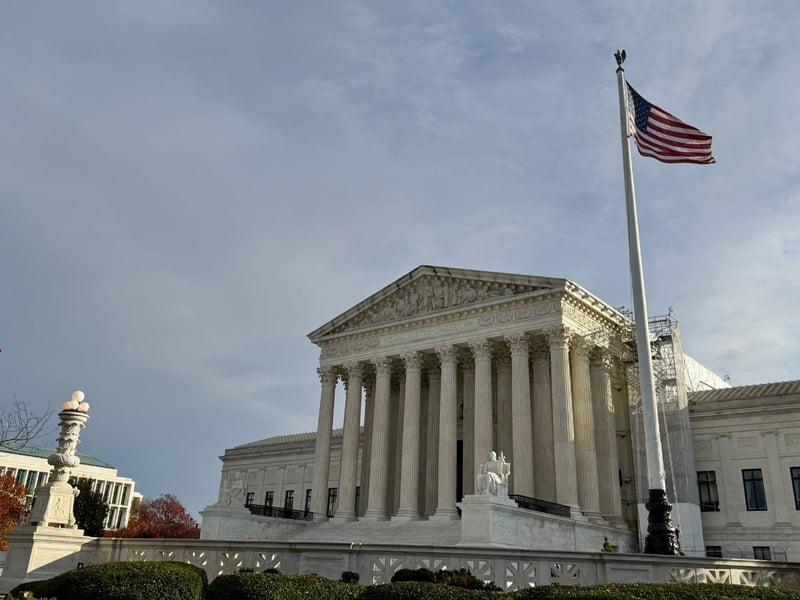
WASHINGTON (CN) — The Supreme Court appeared to easily resolve an excessive force question over a deadly police shooting Wednesday despite the officer’s clash with the facts of the case.
Off the jump, Janice Hughes Barnes presented the justices with a clean getaway from the potentially thorny issue of deadly traffic stops. Barnes, whose son Ashtian Barnes was shot and killed by an officer, argued that the justices only needed to rule that courts should look to the totality of circumstances in excessive force claims.
“The facts show that Officer Felix acted unreasonably,” Nathaniel A.G. Zelinsky, an attorney with Hogan Lovells representing Barnes said. “But this is a court of review, not of first view. The court should rule for [Barnes] on the sole question presented and remand for the lower courts to apply the correct constitutional standard.”
That resolution would leave the Fifth Circuit to weigh whether the specific case at issue here should be considered excessive force.
Barnes’ case claimed that Harris County police officer Roberto Felix violated her son’s rights during a 2016 traffic stop. Felix stopped Ashtian Barnes on as Texas highway as he was driving a rental car to pick up his girlfriend’s daughter. A toll road camera flagged the rental car for unpaid tolls.
During the stop, Felix claimed that Barnes tried to drive off after failing to present his license. In the span of three seconds, Felix jumped onto the moving car and shot Barnes twice. Barnes bled out in the driver’s seat as Felix held him at gunpoint.
A lower court and the Fifth Circuit rejected Barnes’ excessive force claim. They found that in the two-second window when the car accelerated, Felix’s shooting was justified because he reasonably believed that Barnes presented a deadly threat.
Barnes argued the Fifth Circuit was wrong to only considering the “moment of the threat” and should have instead reviewed the totality of circumstances leading up to the shooting.
All the justices seemed open to reversing on that very narrow ground. Felix, however, muddied the waters by suggesting that the court was misreading the opinion. The disagreement set off a back and forth with Felix’s attorney that appeared to incense the justices.
“I understand you read the opinion differently than Justice Kagan does or maybe Judge Higginbotham did,” Justice Neil Gorsuch, a Donald Trump appointee, said referencing the author of the lower court ruling.
Felix’s attorney suggested that the Fifth Circuit considered the totality of circumstances as the justices read the moment of threat holding directly from the ruling.
One point of contention stemmed from Higginbotham’s concurrence. Higginbotham wrote the majority ruling for the panel and a separate solo concurrence stating, “I write separately to express my concern with this circuit’s moment of the threat doctrine, as it counters the Supreme Court’s instruction to look to the totality of the circumstances when assessing the reasonableness of an officer’s use of deadly force.”
Felix’s attorney suggested that Higginbotham couldn’t reasonably believe that the moment of threat doctrine utilized by the Fifth Circuit existed.
“I understand that you think he was not so constrained,” Justice Elena Kagan, a Barack Obama appointee, said. “But we’re supposed to be reviewing this decision, and he was telling us: ‘I, the majority opinion writer, felt that I was constrained to do nothing more than look at the prior two seconds.’"
Felix’s attorney said the difference between the two standards was inane, but that argument was quickly couched by the court.
“The number of remands from this court that lawyers tell us are pointless could fill volumes,” Gorsuch said to laughter in the courtroom.
Despite the apparent unanimity rejecting Felix’s reading of the opinion, the argument session exposed harsh divides on the court over policing. Justice Brett Kavanaugh, a Donald Trump appointee, emerged outspoken in his aversion to limiting officers’ response to threats.
Kavanaugh was concerned about how training manuals would instruct officers to respond when drivers try to escape traffic stops.
“If someone’s pulling away, it could be that they just don’t want the hassle or it could be that they’re about to drive down the street in New Orleans,” Kavanaugh said referencing the New Years Day terror attack. “You don’t know, he could be on drugs and about to kill someone else who’s on a bike on the side of the road.”
Barnes’ attorney said that Felix’s actions created the threat that he then used to justify the deadly shooting. He noted that shooting drivers is particularly dangerous. Because Barnes didn’t die immediately, he was able to put the car into park. Without Barnes’ action, the car could have driven into innocent motorists on the crowded highway, the attorney argued.
“Officer Felix put other people on that highway in grave very serious danger that day,” Zelinsky said. “So I don’t think it’s just that he’s jumping on [the car] to get Ashtian from getting away, it’s also that he’s jumping on [the car] in a manner that is going to put a lot of other people in danger.”
Several justices questioned whether the court needed to define the circumstances when excessive force was reasonable, but Barnes said each case needed to be considered on its own.
“This court has said that it is a fact-specific question that’s going to depend in each given case,” Zelinsky said. “There are no magic rules. There’s no on/off switch. You can’t just start drawing the lines precisely because these cases are so numerous and there are so many different permutations. So I think it would be very dangerous to start drawing those lines.”
 Follow @KelseyReichmann
 Follow @kelseyreichmann.bsky.social
Subscribe to our free newsletters
Our weekly newsletter Closing Arguments offers the latest about ongoing trials, major litigation and rulings in courthouses around the U.S. and the world, while the monthly Under the Lights dishes the legal dirt from Hollywood, sports, Big Tech and the arts.