
 Search Articles


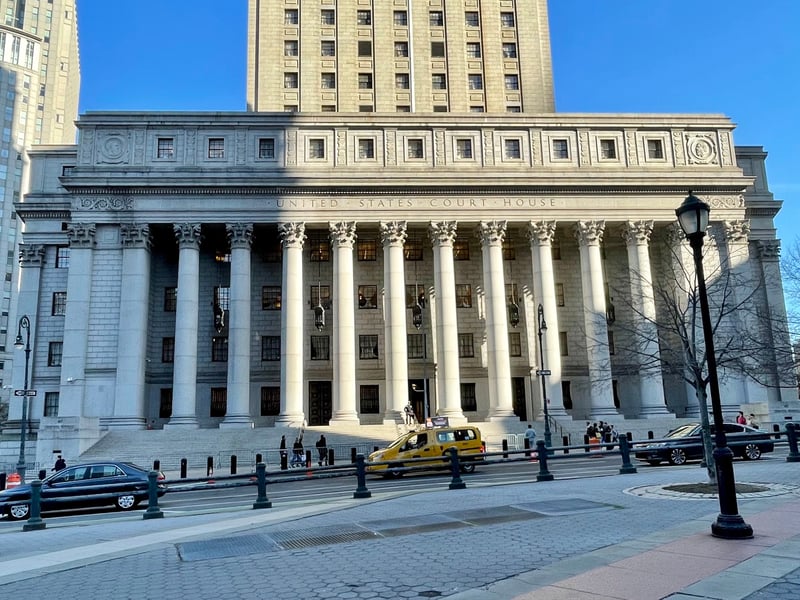
MANHATTAN (CN) — The Second Circuit Court of Appeals on Thursday declined to overturn the federal wire fraud conviction of an embattled former White House education adviser.
Seth Andrew, who worked as a senior adviser in the Obama White House and in the U.S. Department of Education for two years, pleaded guilty in 2022 to a single count of wire fraud. He admitted to moving more than $218,000 from escrow accounts belonging to a New York City charter school system — which he founded in 2005 — into other accounts without authorization.
Andrew was sentenced to 366 days in prison.
But despite having already served his time and being released, Andrew later appealed his conviction on the grounds that the activities he pleaded guilty to were not crimes after all.
Andrew claimed that federal prosecutors used the “right to control” theory of federal wire fraud, which allowed a defendant to be prosecuted for merely withholding funds from victims. That theory was rejected in 2023 by the U.S. Supreme Court in its Ciminelli v. United States ruling, which deemed it unconstitutional. As such, Andrew believes his conviction should be overturned.
The Second Circuit disagreed.
“Ciminelli has no bearing here,” a panel of appellate judges wrote in a seven-page ruling on Thursday. “Contrary to Andrew’s argument, the record reflects that his conviction for wire fraud was not predicated on the right-to-control theory. Andrew was convicted because he stole money belonging to charter schools. The charging information and his own admissions in pleading guilty establish that. Because Andrew was charged with and pleaded guilty to depriving the victims of their money — a traditional property interest — Ciminelli is inapplicable to his conviction.”
Barack Obama-appointed U.S. Circuit Judge Gerald Lynch and Joe Biden-appointed U.S. Circuit Judges Beth Robinson and Sarah Merriam affirmed the lower court’s sentencing and declined Andrew’s motion to file supplemental briefing on the matter.
“I was glad the circuit court saw fit to reexamine these questions of unsettled law and the right to control, but I am disappointed in the panel’s ruling,” Andrew told Courthouse News in a statement. “I pleaded to actions recently deemed non-criminal by the U.S. Supreme Court. I never stole or embezzled any money and while I regret my actions, I felt pressured to plead based on plain error, withheld information and prosecutorial overreach — never criminal intent.”
Andrew represented himself pro se during oral arguments last week in Manhattan. “I served my yearlong sentence and remain on federal probation. My actions cannot sustain a valid federal wire fraud conviction. I am here without counsel, but not without hope,” he told the judges on Sept. 17.
He ran into resistance almost immediately from Lynch, who challenged Andrew’s assertion that his moving of the funds merely deprived the school system, Democracy Prep Public Schools, of control over their assets rather than the assets themselves.
“This seems to me more like you’re making an argument that if a pickpocket takes my wallet, he has deprived me of control of my assets,” Lynch said. “Well yeah, in a sense, but he deprived me of the assets themselves. I no longer have the wallet, and I no longer have the contents of the wallet. So why isn’t this just a straight-up theft of property?”
Andrew replied that, unlike in Lynch’s hypothetical, there were no victims in his case.
“This is not a pickpocket,” he said. “This is a fiduciary obligation I had and I carried out under the guidance of the authorizer, the state of New York, the lawyers and the accountants. There was no intent.”
Arguing for the government, assistant U.S. Attorney Prosecutor Ryan Finkel countered that the victim was the Democracy Prep school system. “He took money from three different schools that were part of the Democracy Prep network. He made two different trips to a bank, multiple deposits, multiple transactions … so there was a victim,” Finkel said.
If Andrew’s appeal was successful, the government would have been able to try Andrew again since he pleaded guilty to the conduct in his criminal complaint. Andrew said that that’s a risk he was willing to take to counter the “great injustice” he said he faced, even after he already completed his time behind bars.
 Follow @Uebey
 Follow @uebey.bsky.social
Subscribe to our free newsletters
Our weekly newsletter Closing Arguments offers the latest about ongoing trials, major litigation and rulings in courthouses around the U.S. and the world, while the monthly Under the Lights dishes the legal dirt from Hollywood, sports, Big Tech and the arts.