Search Articles


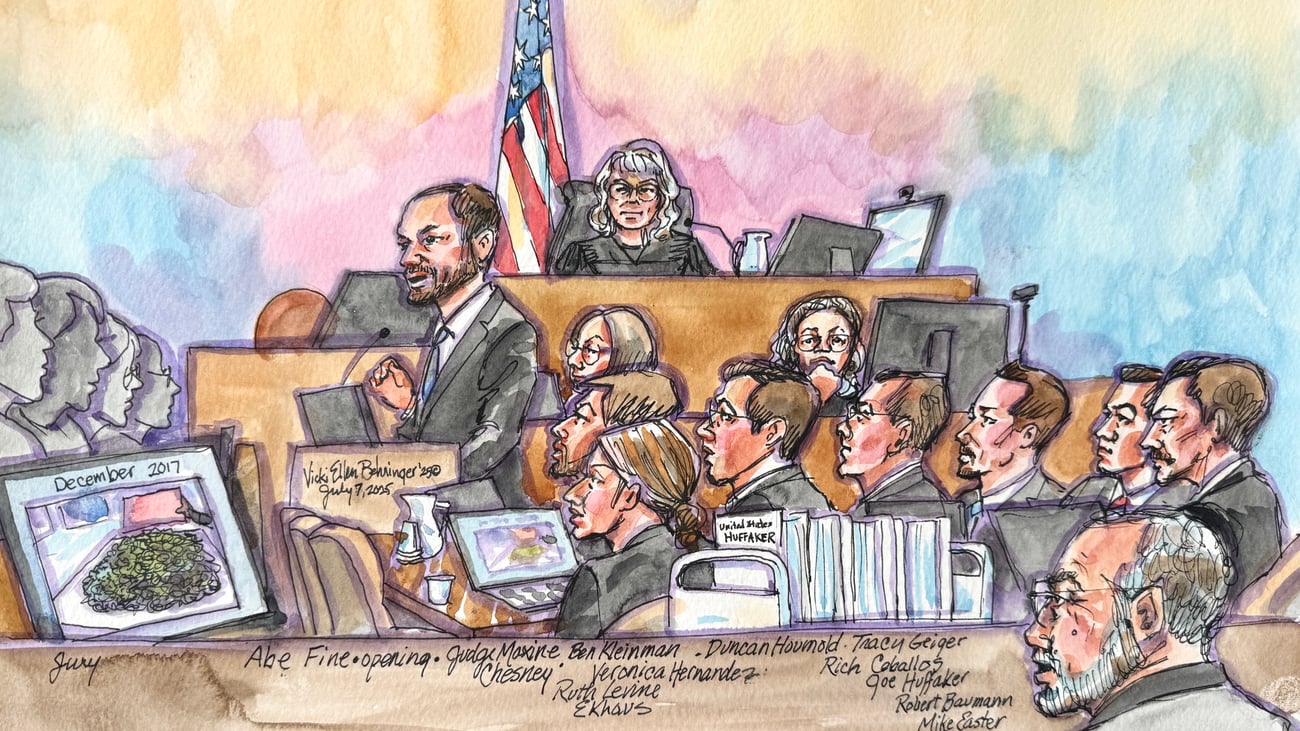
SAN FRANCISCO (CN) — A federal judge Wednesday further postponed the sentencing of a former California police officer convicted of posing as a federal agent to extort marijuana from drivers and then lying to investigators to cover up the crimes.
Joseph Huffaker, 40, who worked for the Rohnert Park Department of Public Safety from 2012 to 2019, was convicted on six counts after a weeklong trial before U.S. District Judge Maxine Chesney. The charges included conspiracy to commit extortion, impersonating a federal officer and falsifying records in a federal investigation.
The case centers on a scheme prosecutors say began after California voters approved Proposition 64 in 2016, legalizing recreational marijuana and ending a lucrative drug interdiction program that had been a source of pride for the small police department about an hour north of San Francisco. Prosecutors said Huffaker and his co-conspirator, former Rohnert Park officer Brendan Jacy Tatum, continued seizing marijuana even after the program was shut down.
The two officers would drive far outside their jurisdiction in an unmarked vehicle, dressed in generic tactical gear without badges and pull over drivers they suspected of carrying large amounts of cannabis. They would then falsely claim to be agents with the Bureau of Alcohol, Tobacco, Firearms and Explosives and threaten arrest if drivers refused to hand over their marijuana.
At Wednesday’s hearing, Chesney denied Huffaker’s motion for a new trial, rejecting claims that details in Tatum’s plea agreement were inconsistent with his testimony at trial.
“The evidence is reconcilable with what is said. It’s not shown to be enough inconsistent to be false,” the Bill Clinton appointee said.
However, Chesney spoke at length about the possibility of postponing Huffaker’s sentencing until after Tatum is sentenced. The judge said she was concerned Tatum may receive a lower sentencing recommendation from the government because of his cooperation, despite his extensive involvement in the scheme.
“My concern is that the government has essentially gotten someone to cooperate down, not up,” Chesney said. “It is undisputed [Tatum] engaged in the behavior alleged here for a considerable amount of time before Huffaker.”
Tatum previously pleaded guilty to charges of extorting marijuana and obstructing justice in 2021 in exchange for cooperating with federal investigators. He testified as a cooperating witness during Huffaker’s trial.
Abraham Fine of the U.S. Attorney’s Office argued against postponing Huffaker’s sentencing, telling Chesney that the government was ready to proceed to sentencing and there was no reason to have Huffaker and Tatum sentenced at the same hearing.
Fine also said Tatum’s lawyers had “strenuously objected” to sentencing the two men on the same day, though he later acquiesced to scheduling both sentencing hearings on May 6 after a brief sidebar with Tatum’s attorney, Stuart Hanlon, who was present in the gallery.
The judge additionally pressed Fine multiple times about the government’s position on sentencing recommendations for Tatum, saying cooperation with the government should go “lightweight guy against heavy.”
“What is going to happen to the person who started it all, Mr. Tatum? To put Mr. Huffaker to a certain extent in a frame of reference, that is what I am thinking about,” she said.
Fine did not answer Chesney directly, saying he needed specific approval to divulge the information. However, he clarified that the government’s position was that “Tatum was the worse actor.”
“Despite Mr. Huffaker going to trial, Mr. Tatum should get a higher sentence than Huffaker. That is our position right now, certainly,” he said.
At the end of the hearing, Chesney ordered that both defendants would be sentenced on May 6, with Tatum scheduled first.
The government is seeking more than a five-year sentence for Huffaker, while the probation office is recommending just two years. Huffaker is asking for three years’ probation, with one year home confinement and 500 hours of community service.
Representatives for the parties did not respond to a request for comment.
Huffaker’s and Tatum’s plot began to unravel after a Dec. 18, 2017, traffic stop in which the officers seized over 20 pounds of marijuana from Barron Lutz, owner of a marijuana company called Humboldt Private Reserve. Lutz was transporting the cannabis to the Bay Area for required lab testing when he was pulled over by the unmarked SUV equipped with police lights.
“I didn’t know if I was being robbed or arrested. I felt confused,” Lutz testified during the trial. When he asked for documentation of the seizure, he said the officers responded with a veiled threat: “They asked me if I wanted to make a large federal case of it, or if I’d prefer to be let go. I said I’d prefer to be let go.”
The scheme marked a dramatic fall for officers once praised for their drug enforcement work. During the legitimate drug interdiction program that ran from 2014 to early 2017, Tatum had won awards and seized over 4,000 pounds of marijuana, 20 firearms, a dozen vehicles and more than $4 million.
However, the interdiction team was disbanded in January 2017, following the approval of Proposition 64, which legalized recreational marijuana. When Tatum and Huffaker approached Brian Masterson, then-police chief of the Rohnert Park Department of Public Safety, about continuing enforcement through a federal partnership, Masterson shut them down.
“I told them ‘absolutely not,’” he testified at trial, adding that it was “pretty clear” the voters had approved marijuana legalization. “I think both Sgt. Tatum and Officer Huffaker were a bit disappointed.”
 Follow @mhattridge_
Subscribe to our free newsletters
Our weekly newsletter Closing Arguments offers the latest about ongoing trials, major litigation and rulings in courthouses around the U.S. and the world, while the monthly Under the Lights dishes the legal dirt from Hollywood, sports, Big Tech and the arts.
Additional Reads
 Penis costume protester prevails in court April 15, 2026
 Sotomayor apologizes to Kavanaugh for ‘hurtful’ comments April 15, 2026
 California bill would ban cellphones in schools April 15, 2026