Search Articles


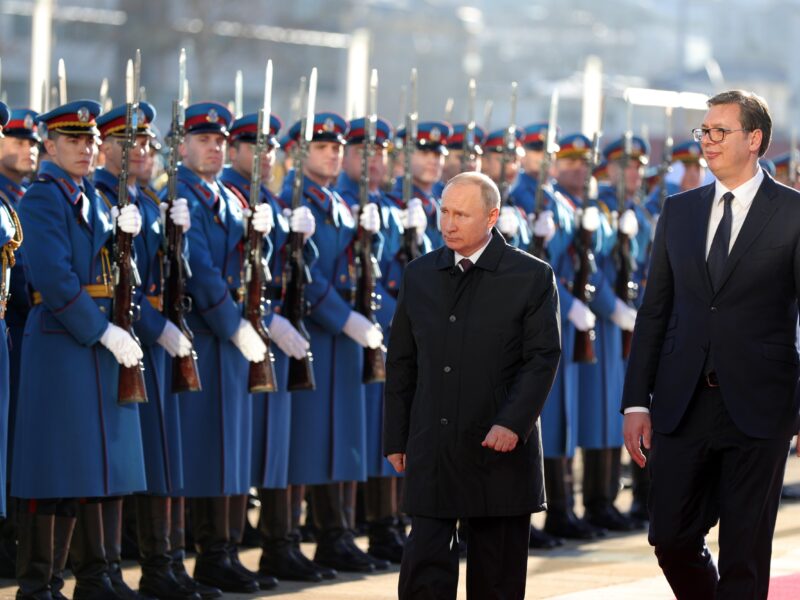
(CN) — Serbia may be heading toward early parliamentary elections after the country’s longtime president, populist strongman Aleksandar Vučić, vowed to resign but seek to hold onto power by becoming prime minister.
Vučić’s announcement was a response to nearly 20 months of mass student-led anti-corruption protests against his government. The protest movement has spawned a formidable political opposition that has made demands for new elections a chief aim.
During a weekend speech in Belgrade in front of his supporters, Vučić said he would resign after “a few weeks,” a move that would trigger presidential elections within 90 days of his resignation and lead to parliamentary elections too. But he did not clarify when they may take place. Pundits believe parliamentary elections could be held this autumn.
Vučić is preparing to remain Serbia’s dominant political figure by moving from the president’s office to the prime minister’s spot — a ploy reminiscent of how ally Vladimir Putin held onto power in Russia.
Vučić is nearing the end of his second term as president and he is barred from running for a third term. He previously served as prime minister in 2014 before winning the presidency in 2017. Although the presidency is designed to be a mostly symbolic role in Serbia, Vučić turned the office into the country’s main political force.
Vučić’s machinations were aimed at quelling protests and retaining power, according to Mak Kasapovic, a Balkans expert at Oxford Analytica, a firm that analyses geopolitical risks.
“It is true enough that Vučić will seek the premiership, but I don’t think he will do so just yet,” Kasapovic said. “More likely, the resignation would be a gambit aimed at feigning change at the top in a bid to disarm the protests, and then testing the electoral ground with the less consequential presidential elections before the parliamentary polls.”
The possibility of elections raised tensions in Serbia, which has been in the grip of student-led protests following the deadly collapse of a concrete canopy at a renovated train station in November 2024.
The disaster resulted in the deaths of 16 people in the city of Novi Sad, most of them students, and became a rallying call against deep corruption in Serbia.
The protests and the government’s tough and often violent response to demonstrations sharpened tensions within Serbia, a Balkans nation riven by conflicts stemming from the Yugoslav wars of the 1990s and its geopolitical position straddling the European Union and the West and Russia and China.
Vučić plans to lead his governing Serbian Progressive Party’s “United Serbia” list in the next parliamentary elections.
Polls show Vučić’s factions may be able to obtain a majority against a student-led electoral list. But the elections would be a referendum on his 12 years in power and the race could be close.
“The upcoming electoral period will bring increased public tensions and heightened uncertainty about the country’s political direction and wider business environment,” Teneo, a political risk firm, said in a briefing note.
Kasapovic said Vučić’s Serbian Progressive Party “remains in a relatively strong position” given “the skewed political playing field in Serbia” and the weakness of opposition parties.
“But he’s far from certain to be able to form the next government,” he added.
He said the Serbian Progressive Party has won a series of local elections since the Novi Sad disaster, though mostly in rural municipalities. At the same time, these elections have “exposed that the party’s support is declining, even in its rural heartlands, as the protester-backed lists performed rather well in many of those contests.”
Despite the mass protests, Vučić’s government has weathered a crisis that saw Prime Minister Miloš Vučević resign in January 2025 after five students involved in protests in Novi Sad were beaten. The protest movement has kept going strong and continues to draw massive crowds.
Vučić has sought to calm the anger with vows to investigate the canopy collapse and ensure those responsible are prosecuted. So far, though, no one has been convicted for the disaster.
In April, a commission investigating the canopy collapse found that a “criminal group” responsible for the disaster was being shielded by the “combined efforts of the legislative, executive and judicial branches,” as reported by N1, a Serbian news outlet.
The commission warned that Serbia was drifting further “from identifying those responsible and bringing them to justice,” N1 reported.
In October 2025, the commission said it believed Vučić acted as the leader of the “criminal group” behind the canopy’s collapse and called for his close associates to be investigated, as reported by Serbian media.
Courthouse News reporter Cain Burdeau is based in the European Union.
 Follow @cainburdeau
Subscribe to our free newsletters
Our weekly newsletter Closing Arguments offers the latest about ongoing trials, major litigation and rulings in courthouses around the U.S. and the world, while the monthly Under the Lights dishes the legal dirt from Hollywood, sports, Big Tech and the arts.