Search Articles


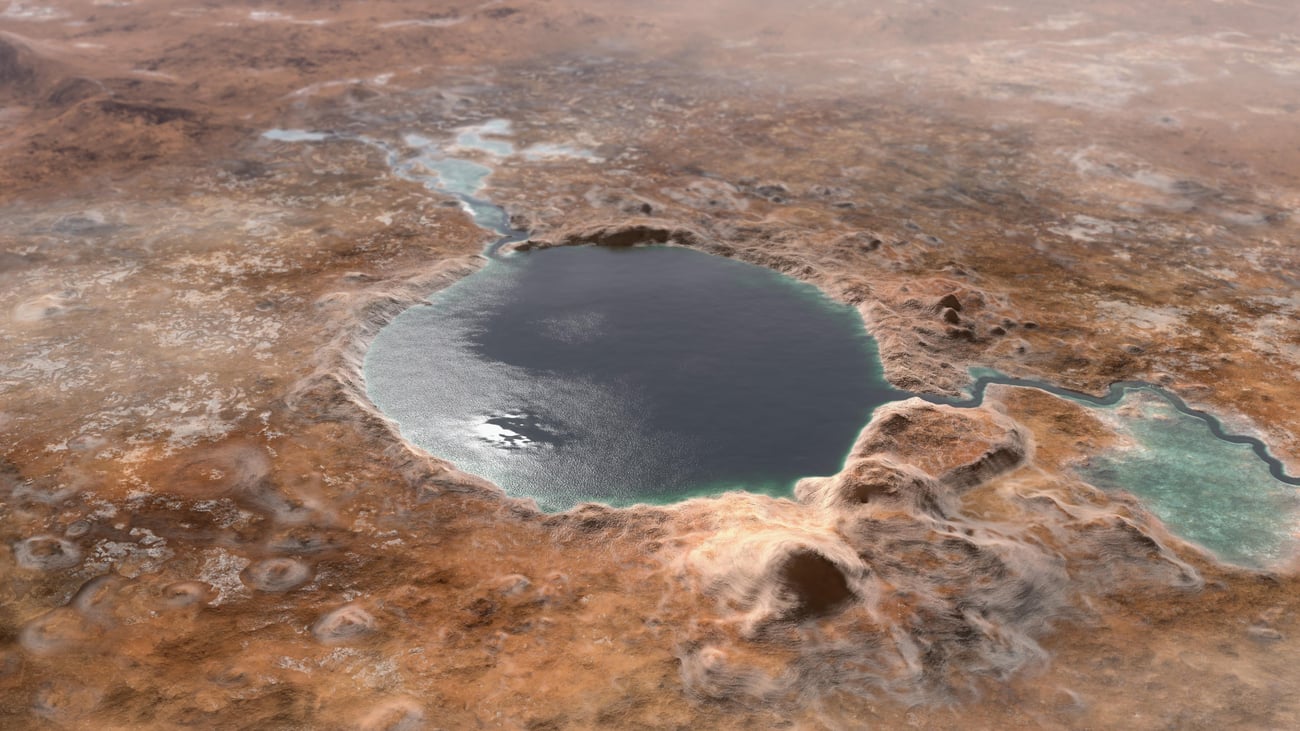
(CN) — Scientists have found organic carbon in mudstones from what was once a Martian lake, they write in a new study, adding to a growing body of evidence that the red planet once harbored life.
In a paper published Wednesday in the journal Science Advances, a team of researchers led by NASA scientist Kyle Uckert and Planetary Science Institute researcher Ashley Murphy analyzed data from the Perseverance rover. The rover landed on Mars in 2021 with the mission of searching the Jezero crater — which was once a water-filled lake — for evidence of past life on Mars.
Using a process known as Raman spectroscopic mapping, the scientists analyzed the chemical makeup of sedimentary rocks from an outcrop called “Bright Angel,” in an ancient Martian river valley that brought water into the crater billions of years ago. The results indicate the presence of organic carbon — a building block of life.
“Measurements of two mudstones show hundreds of organic detections, making this the most robust organic detection in Jezero crater thus far, and the first detection of macromolecular carbon on a natural rock surface on Mars,” the researchers write.
The surface of Mars experiences processes like radiation and oxidation that are destructive to organic compounds, leading the researchers to speculate the organic carbon detected by Perseverance may have been exposed to the surface relatively recently, or be resistant to such processes.
While the researchers don’t know if the organic carbon came from living organisms, their findings add weight to a growing body of evidence.
“These detections also represent an organic-bearing mudstone more than 3500 km (2,175 miles) away from the detections reported from Curiosity rover measurements in Gale crater, which indicates that the habitability of Mars, and the availability of organics, may have been widespread across the planet billions of years ago,” the scientists write.
The findings come a year after the Perseverance rover found chemical patterns in the same area that could indicate ancient microbial activity. Scientists found that mudstones from Bright Angel were dotted with specks — dubbed poppy seeds and leopard spots — enriched with iron phosphate and iron sulfide.
On Earth, those compounds are formed as byproducts when microorganisms consume organic matter, and a similar process may have occurred on Mars.
NASA’s science mission chief Nicky Fox said at the time it was “the closest we’ve actually come to discovering ancient life on Mars.”
Subscribe to our free newsletters
Our weekly newsletter Closing Arguments offers the latest about ongoing trials, major litigation and rulings in courthouses around the U.S. and the world, while the monthly Under the Lights dishes the legal dirt from Hollywood, sports, Big Tech and the arts.