
 Search Articles


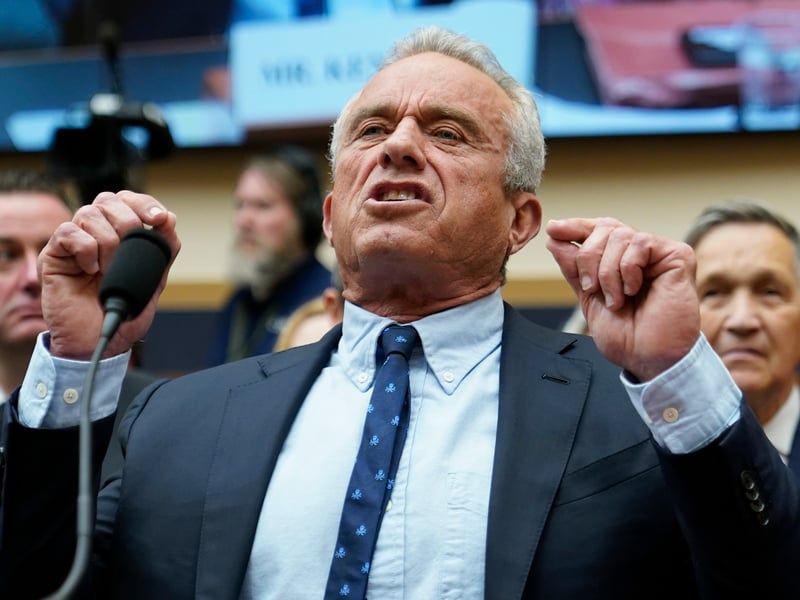
(CN) — Three appellate judges of the Sixth Circuit ruled last month that Robert F. Kennedy Jr. would stay on the presidential ballot in Michigan, despite withdrawing as a presidential candidate in August.
Then the appellate court ruled the same way again on Wednesday — or at least, some of it did.
By way of a convoluted series of opinions that capped off a convoluted series of state and federal court battles, a Sixth Circuit panel on Wednesday denied Kennedy a chance to take his case before the full appellate court. Three Sixth Circuit judges wrote in support of that denial, two issued dissents, and Senior U.S. Circuit Judge David McKeague issued a technically-neutral statement that nevertheless makes clear he would have given Kennedy another chance to make his case.
That case began in late August, after RFK Jr. officially withdrew as a presidential candidate. In Michigan, Kennedy ran as the nominee of the Natural Law Party — a party associated with the Transcendental Meditation movement — but after ending his campaign he endorsed former President Donald Trump and attempted to remove his name from the Michigan ballot. Michigan’s Democratic Secretary of State Jocelyn Benson shut down that effort, citing a Michigan law which states that past a certain deadline, “candidates nominated and certified shall not be permitted to withdraw.”
Benson kept Kennedy’s name on the ballot, and he sued for First Amendment violations in response. His complaint resulted in a series of conflicting rulings on the issue from ever-higher levels of the state and federal courts, including a ruling from the Michigan Supreme Court that his name would stay on the ballot. Higher up the judicial food chain, the Sixth Circuit also came down in favor of Benson — and RFK Jr.’s inclusion on the ballot — on Sept. 27, nine days after the U.S. District Court of Eastern Michigan had decided likewise. Both federal judicial decisions were controversial.
Benson argued in court filings that to take Kennedy’s name off the ballot would disrupt election procedures and deprive Natural Law Party voters of a candidate. U.S. District Judge Denise Page Hood agreed, as did the majority of the Sixth Circuit panel hearing Kennedy’s appeal of her ruling.
“The public interest is perhaps the most paramount here. By the time the district court ruled, at least 45 of Michigan’s counties, including its two largest ones, had begun to print ballots,” U.S. Circuit judge Eric Clay, a Bill Clinton appointee, wrote for the appellate panel’s majority opinion. “Changing the ballot at this late a date would be even more disruptive. The ballots are now printed.”
But McKeague, a George W. Bush appointee, argued that Benson decided to keep RFK Jr. on the ballot first and came up with explanations for her decision later.
“The Michigan Supreme Court order simply found that Kennedy was not entitled to mandamus relief. It did not order her to alter the list of candidates that was already distributed to the county clerks. It did not set aside the statutory deadline. It did not justify a post hoc alteration of the ballot,” McKeague wrote.
With the presidential election less than three weeks away, most polling shows Democratic Vice President Kamala Harris only narrowly leading Trump. Kennedy endorsed Trump and at least some of his supporters, if they couldn’t vote for him, would likely gravitate toward the former president.
McKeague worried that Benson, by forcing a reluctant third party candidate to keep his name in the ring, had illegally tipped the scales in a key battleground state.
“Secretary Benson’s decision to add Kennedy to the ballot was arbitrary. It was unchecked. It conveys a message that Kennedy does not wish to send. And it will cause voters to waste their fundamental right to vote,” the appellate judge argued.
McKeague repeated that argument on Wednesday when a Sixth Circuit panel denied Kennedy’s motion to have his case heard en banc, or by the full appellate court rather than just a three-judge panel. McKeague only issued a “statement” on the matter, but two other Trump-appointed U.S. circuit judges, Chad Readler and Amul Thapar, echoed his concerns.
“A state official mandated a former candidate’s appearance on the presidential ballot over the candidate’s objection. That fact alone would likely strike any reasonable observer as odd,” Readler wrote in his dissent.
Thapar noted that presidential elections are of a uniquely important national interest.
“If this case didn’t raise ‘questions of exceptional importance’ appropriate for en banc review, it’s hard to imagine what case would,” Thapar wrote.
Two judges who wrote in support of the decision, conversely, repeated arguments raised by Hood and the appellate court’s prior ruling.
“The November general election is well underway in Michigan. More than 670,000 Michiganders have already voted. Irrespective of the correctness of the Michigan Secretary of State’s decision to place Natural Law Party presidential nominee Robert F. Kennedy, Jr. on the ballot, the genie is out of the bottle,” U.S. Circuit Judge Richard Griffin, a George W. Bush appointee, wrote in a concurrence. He was joined in his opinion by Andre Mathis, a Joe Biden appointee.
Clay issued a separate concurrence Wednesday in which he highlighted another issue: even as Kennedy sought to take his name off the Michigan ballot, he sued to have his name included on the ballot in safer, bluer New York. The circuit judge waved off RFK Jr.’s claims as “bogus” in light of the contradiction.
“We cannot discern Plaintiff’s personal and/or political motives for advancing completely contradictory arguments in different jurisdictions; however, the duplicitous nature of his arguments, which vary from state to state, have absolutely nothing to do with any desire on Plaintiff’s part to protect the sanctity of his First Amendment rights,” Clay wrote.
 Follow @djbyrnes1
Subscribe to our free newsletters
Our weekly newsletter Closing Arguments offers the latest about ongoing trials, major litigation and rulings in courthouses around the U.S. and the world, while the monthly Under the Lights dishes the legal dirt from Hollywood, sports, Big Tech and the arts.