
 Search Articles


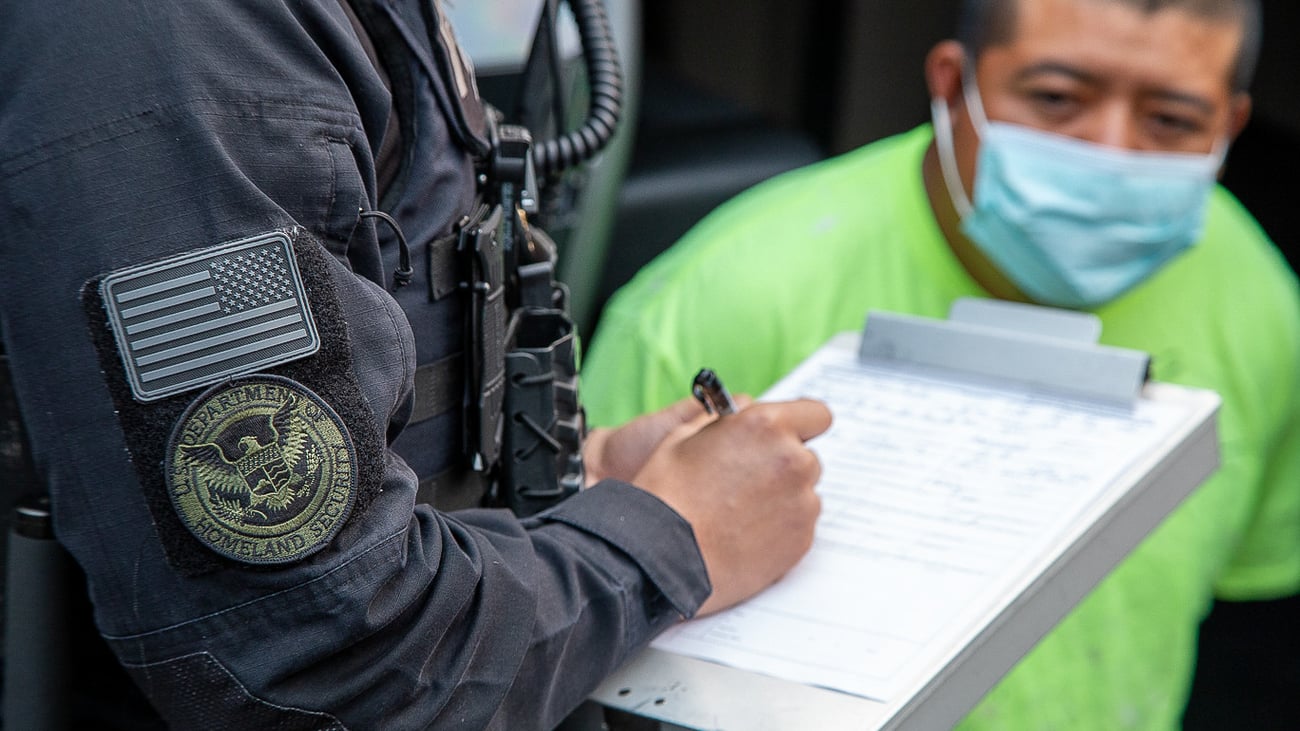
WASHINGTON (CN) — In a 6-3 ruling on Tuesday, the Supreme Court refused to limit when border officers can put certain green card holders on parole.
The conservative majority broke in favor of the Trump administration on the weedy immigration question before them that asked when lawful permanent residents, as they are formally known, can be temporarily stripped of some of the benefits of their permanent status.
Writing for the high court, Justice Clarence Thomas said the evidence burden for such a demotion shouldn’t be on border officers who are entrusted with making “quick judgments on the spot.”
The three liberal justices balked at their colleagues’ decision, worrying that the court had handed the government “a massive blank check” to undermine the benefits and security that come with having a green card.
“Congress could not have meant for the guarantees it was affording to be so cavalierly swept aside,” Justice Ketanji Brown Jackson, a Joe Biden appointee, wrote in dissent. “By law, [lawful permanent residents] are as close to citizenship as one can get absent naturalization. Today, the majority ignores that crucial fact and empowers government officials to act accordingly.”
The case before the court concerns a key benefit for green card holders: admission into the United States when returning from travel abroad. Under the Immigration and Nationality Act, green card holders who commit crimes of moral turpitude can be stripped of that benefit and classified as seeking admission, allowing border agents to parole them into the country for deferred inspection.
Being paroled into the country versus being admitted carries legal significance, including losing access to documents required to live and work in the U.S.
Muk Choi Lau — who has been a lawful permanent resident since 2007 — was paroled after returning from a trip to China in 2012.
At the time, Lau was facing pending charges for trademark counterfeiting. Based on the government’s indictment, a border agent determined that Lau would be considered seeking admission under the crime-involving-moral-turpitude exception, stripping him of his green card benefits upon reentry.
After Lau pleaded guilty, the border agent’s determination allowed the government to initiate removal proceedings against him. But Lau challenged the move, arguing that if the government wanted to expel him, it had to do so through deportation proceedings.
While both deportation and inadmissibility removal have the same end point, their proceedings and requirements vary. Immigrants without legal status can be admitted into the U.S. on parole, granting them temporary permission to enter the country. While physically on U.S. soil, they are still legally considered to be at the border for purposes of immigration laws.
Green card holders are only subject to parole upon reentry under certain circumstances. The Trump administration asked the court to uphold border officers’ authority to parole green card holders who face criminal charges.
Immigrant advocates said the border officers needed clear and convincing evidence — such as a conviction or confession — to find that a lawful permanent resident fit the criteria at the time they returned to the U.S.
Applying a looser standard, the government argued that the border agent only needs a good faith belief the green card holder committed a qualifying offense. An immigration judge would then make a final determination at a later date, potentially using evidence gathered while the immigrant was paroled.
The Supreme Court sided with the Trump administration, holding that the government only has to provide clear and convincing evidence that a green card holder should be paroled at the time of their removal hearing, not at the border.
“Here, the government satisfied its burden at the hearing based ‘on the evidence produced at the hearing:’ Lau’s guilty plea was clear and convincing evidence that, before he attempted to reenter the country, he had committed the crime in question,” wrote Thomas, a George H.W. Bush appointee.
According to the liberal justices, the decision will allow the government to downgrade a green card holder’s status at the border based on assumptions that must only be proved at a later removal hearing with evidence accrued in the meantime.
Without the protections of permanent status, Jackson said residents could be subject to detention or have their identification documents confiscated. She noted that having a temporary green card makes it harder to work, open bank accounts, secure housing, obtain health insurance and enroll in school.
“So an [lawful permanent resident] in Lau’s position could lose his ability to work within a year of being paroled, and without the security of a permanent green card, could then face the downstream consequences of being unemployed and unemployable for however long the legal limbo continues,” Jackson wrote.
While paroled green card holders could be acquitted and regain their status, Jackson said this would be a cold comfort.
“It is a fundamental maxim in our country that all are innocent until proven guilty,” Jackson wrote.
 Follow @KelseyReichmann
 Follow @kelseyreichmann.bsky.social
Subscribe to our free newsletters
Our weekly newsletter Closing Arguments offers the latest about ongoing trials, major litigation and rulings in courthouses around the U.S. and the world, while the monthly Under the Lights dishes the legal dirt from Hollywood, sports, Big Tech and the arts.
Additional Reads



 Justices slam court doors on foreign torture claims June 23, 2026