
 Search Articles


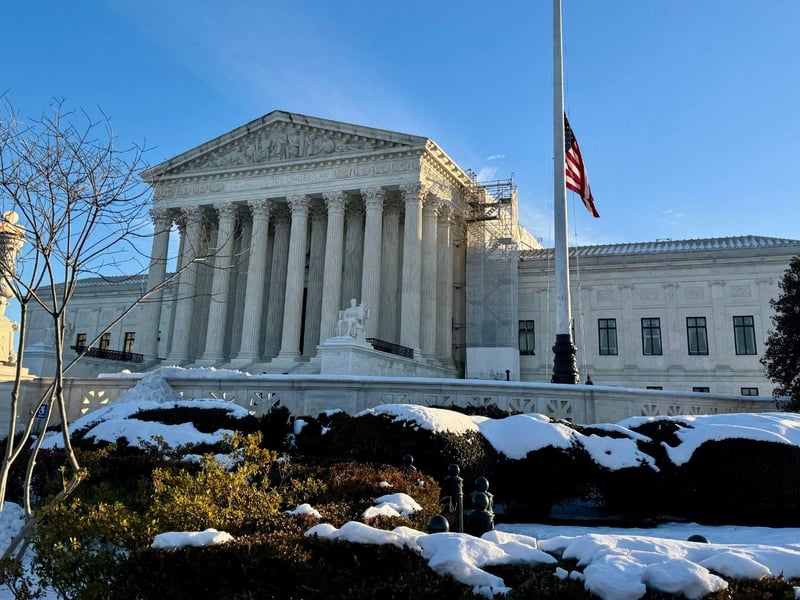
WASHINGTON (CN) — The Supreme Court put a federal financial reporting law back on the books Thursday, forcing companies to disclose information that is used by malign actors to conceal their ownership and facilitate illicit activities.
A Texas judge issued a nationwide pause on the Corporate Transparency Act after finding that the financial transparency law was likely unconstitutional. In December, the Biden administration pushed the justices to overturn the lower court order, arguing that Congress was within its Commerce Clause authority to regulate economic activities impacting interstate commerce.
The Supreme Court granted the government’s request but did not explain its decision.
Justice Ketanji Brown Jackson, a Joe Biden appointee, was the sole public dissenter from the order.
“However likely the Government’s success on the merits may be, in my view, emergency relief is not appropriate because the applicant has failed to demonstrate sufficient exigency to justify our intervention,” Jackson wrote.
Jackson reasoned that the Fifth Circuit already agreed to expedite the appeal so there was no reason for the court to step in. She also noted that the government delayed enforcing the law by four years, negating the suggestion that grave harm would come from any additional delay.
The 2021 law targets financial crimes like money laundering, tax fraud, human and drug trafficking, and the financing of terrorism. Lawmakers ordered corporations and other entities to report information about their owners to allow the government to detect and prosecute those crimes and discourage the use of shell companies to conduct illicit activity.
Companies formed before 2024 were supposed to file reports by the start of 2025 but ongoing litigation over the law’s constitutionality delayed those filings. A lower court ruled that Congress likely overstepped its enumerated powers and issued a preliminary injunction halting the law’s enforcement nationwide.
A firearms dealer, information technology company, dairy farm and political party filed a joint challenge to the law. Led by Texas Cop Shop, the businesses claimed that the CTA’s unprecedented reporting regime would cost tens of billions of dollars and violate their First and Fourth Amendment rights from being compelled to disclose private information.
Texas Cop Shop said the law covers about 32.6 million existing companies and five million new reporting companies formed each year.
“Compliance in the first year alone would take 126.3 million hours and impose costs of $22.7 billion,” the gun dealer wrote. “The estimated burden hours include filing initial reports, reviewing information and complying with ongoing duties to update them when information changes.”
The federal government said the businesses’ cost assessment was overstated. According to government estimates, it should only take companies around 90 minutes to complete the reporting documents, with the compliance time equivalent to $85.14.
The federal government used the application as an example of growing problems with universal injunctions.
“The universal injunction in this case represents a particularly stark departure from traditional equitable principles,” former U.S. Solicitor General Elizabeth Prelogar wrote. “The district court granted universal relief to respondents even though respondents did not ask for it.”
Universal injunctions create high stakes for the government. Challengers only need to win one lawsuit of many to block a federal regulation nationwide, while the government must prevail in every lawsuit just to keep its policy in force.
“Under Article III, however, ‘courts are not roving commissions assigned to pass judgment on the validity of the Nation’s laws,’” Prelogar wrote. “‘Constitutional judgments’ are instead ‘justified only out of the necessity of adjudicating rights in particular cases between the litigants.’ The district court thus had no authority to grant relief to persons who were not ‘plaintiff [s] in this lawsuit, and hence were not the proper object of [the court’s] remediation.’”
Justice Neil Gorsuch, a Donald Trump appointee, said that he would have granted full review of the government’s petition to resolve whether district courts may issue universal injunctive relief.
 Follow @KelseyReichmann
 Follow @kelseyreichmann.bsky.social
Subscribe to our free newsletters
Our weekly newsletter Closing Arguments offers the latest about ongoing trials, major litigation and rulings in courthouses around the U.S. and the world, while the monthly Under the Lights dishes the legal dirt from Hollywood, sports, Big Tech and the arts.