
 Search Articles


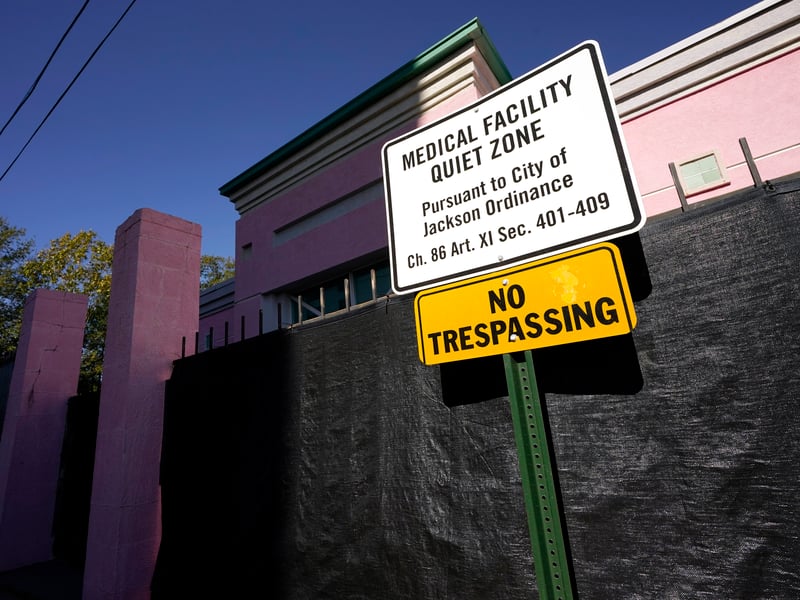
WASHINGTON (CN) — The Supreme Court refused on Monday to reconsider a decades-old precedent creating a protest-free zone around abortion clinics to protect doctors and patients.
Nonprofit Coalition Life asked the justices to overturn Hill v. Colorado , in which the justices found that Colorado could prevent speakers from approaching abortion patients without their consent.
The group — whose stated mission is ending abortion — urged the justices to use a now-defunct Illinois law restricting how so-called “sidewalk counselors” protest to toss the 2000 precedent now that Roe v. Wade is no longer the rule of the land.
“Dobbs should have made clear beyond cavil that Hill could no longer skew public debate on a divisive issue being returned to the people,” Coalition Life wrote in its petition.
Justice Clarence Thomas, joined by Justice Samuel Alito, dissented and made clear he agreed with the anti-abortion group that Hill should be overturned.
“Hill has been seriously undermined, if not completely eroded, and our refusal to provide clarity is an abdication of our judicial duty,” the George H. W. Bush appointee wrote. “I would have taken this opportunity to explicitly overrule Hill. For now, we leave lower courts to sort out what, if anything, is left of Hill’s reasoning, all while constitutional rights hang in the balance.”
Thomas decried the high court’s reasoning in Hill, citing the dissents of his former colleagues, Justice Antonin Scalia and Justice Anthony Kennedy, which he joined in the 6-3 case.
There, the majority deemed the Colorado law content neutral because it did not prohibit a particular viewpoint or subject matter. Thomas said that determination was a singular occurrence where the court applied “such a narrow view” of content-based speech restrictions.
Thomas asserted that the court reviewed the law under the lower intermediate scrutiny standards solely because the issue at hand was abortion, which Scalia characterized in his Hill dissent as an “ad hoc nullification machine” meant to strike down any doctrines that “stand in the way” of abortion.
“Hill’s abortion exceptionalism turned the First Amendment upside down,” Thomas said, quoting from Scalia’s dissent. “Hill manipulated this court’s First Amendment jurisprudence precisely to disfavor ‘opponents of abortion’ and their ‘right to persuade women contemplating abortion that what they are doing is wrong.’”
In Dobbs v. Jackson Women’s Health Organization , Alito, a George W. Bush appointee, cited Hill as a distortion of the First Amendment. Coalition Life argued that since abortion access was returned to the states, speech restrictions at clinics should be too.
“Yet as things stand, jurisdictions in which anti-abortion views are disfavored have a ready tool to try to silence those who advance them — and to do so precisely when and where their speech may matter most,” the group wrote.
Coalition Life said federal restrictions on abortion-related speech were antithetical to the First Amendment and urged the court to vindicate the First Amendment by overturning Hill .
The City of Carbondale, Illinois, said Coalition Life was advancing its trumped-up case to achieve its political goals. Carbondale enacted a buffer zone around medical facilities after Dobbs to combat increased patient harassment and intimidation. But the ordinance was repealed before it could even be enforced.
Carbondale said that with no law left to challenge, instead of dropping its lawsuit, Coalition Life wanted to use its challenge to overturn a ruling it disagreed with.
“This unusual litigation tactic was likely designed to take advantage of a perceived window of opportunity after Dobbs v. Jackson Women’s Health Organization ,” the city wrote in its brief. “Petitioner wants to fast-track a request that this Court overturn Hill just as it overturned Roe v. Wade .”
The city said it experienced an uptick in intimidation, threats and interference from anti-abortion protesters. Carbondale said its ordinance responded to a real public safety concern.
Carbondale’s city council unanimously passed the ordinance, prohibiting protesters from being within eight feet of anyone entering a clinic, and created a 100-foot demonstration-free zone around health care facilities.
However, the council repealed the ordinance in July 2024, noting that it hadn’t been enforced and that other ordinances and state laws were sufficient protection against disorderly conduct.
Thomas acknowledged that fact in a footnote, but said the case should still stand because the ordinance was in effect for over a year and a half and thus Coalition Life still could seek damages for First Amendment violations.
Further, Thomas noted the Supreme Court has had many chances to reconsider Hill but has passed on reviewing them due to “thorny preliminary issues,” which he said Coalition Life’s case did not have.
“This case would have allowed us to provide needed clarity to lower courts,” Thomas wrote.
 Follow @Ryan_Knappy
Subscribe to our free newsletters
Our weekly newsletter Closing Arguments offers the latest about ongoing trials, major litigation and rulings in courthouses around the U.S. and the world, while the monthly Under the Lights dishes the legal dirt from Hollywood, sports, Big Tech and the arts.