
 Search Articles



MEXICO CITY (CN) — Uber driver Antonio Palacios was almost on his way after picking up a passenger at Mexico City International Airport on Sunday afternoon. As he put his car in gear, a National Guardsman pulled him over to the side of the arrivals area of Terminal 2.
Mexico’s National Guard sanctions taxi drivers who do not adhere to airport rules, which can include entering the airport when not permitted, though the rules aren’t entirely clear.
The guardsman asked to see Palacios’ papers and driver’s license while the passenger in the back seat looked on, bewildered.
“He said Ubers aren’t allowed here right now to pick up passengers,” said Palacios. “They’re going to give me a fine, and then let me go.”
After about a 10-minute wait while the guardsman wrote out the paperwork, Palacios was correct: A $40 fine for entering the federal zone of the Mexico City International Airport to pick up a passenger.
An average trip from the Mexico City International Airport to the city’s downtown is around $15.
“You can come to drop off people now, but not to pick them up, apparently,” he said.
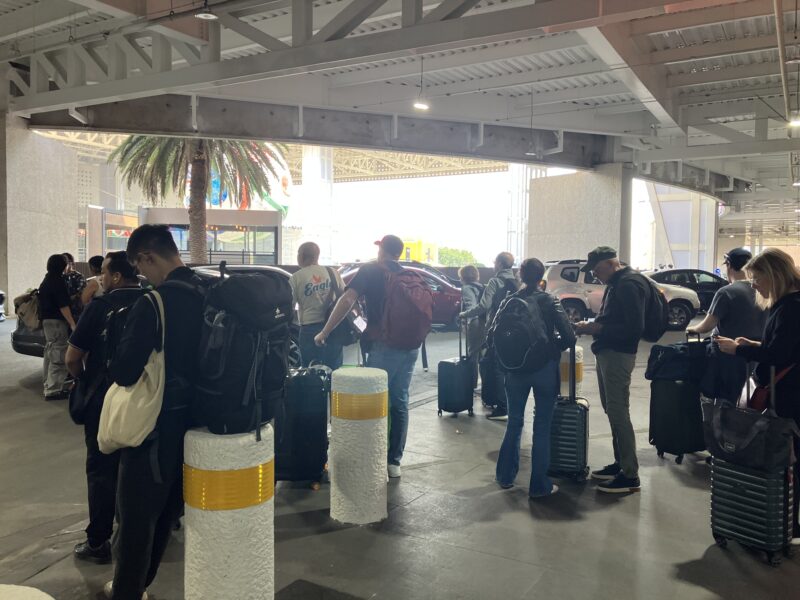
Palacios was ticketed while dozens of people waited for their Ubers, and almost all of them zoomed off successfully despite the apparent rules prohibiting them.
Kaitlyn Smith, who traveled from Boston with her family, waited for her ride for 20 minutes after an Uber driver canceled. Eventually, the family rode off with success.
An Uber driver who did not want to provide his name said the rules change daily, sometimes even by the hour — creating uncertainty for drivers and their passengers.
“This makes it very difficult for us to do our jobs, especially with the World Cup coming up,” said the driver. “We hope that they will let us work and let us have access to the airport.”
One couple visiting from New York had to vacate their Uber after the National Guard stopped it. The driver, too, was given a ticket, but this time he left the airport without a passenger.
“We assume he didn’t have his papers in order or something,” said Quincy Goss.
“We were here a couple months ago, and we had to leave the airport area and order an Uber from outside the terminal,” said David Kjartansson as they waited for their next Uber to arrive.
Mexico City resident Ricardo Austria, traveling from Veracruz, chose to use an airport-authorized taxi company, Sitio 300, but still waited around 20 minutes.
He, too, was unsure of the rules but knew that Uber drivers didn’t have complete access to the airport.
“Ubers are prohibited from entering this area. I think they have a designated area, but I don’t know if it’s only in Terminal 1 or if Terminal 2 also has an assigned area. But I mean, the thing is, the areas aren’t very well defined,” said Austria. “It’s a little strange, though, whenever I come here, there’s usually no line. This is the first time I’ve had to wait in line. I imagine it’s because of the World Cup and all that. People are starting to arrive.”
Mexico City will host the FIFA World Cup’s inaugural match on June 11.
Gibran Hernández Martínez, a 17-year veteran driver for airport-authorized taxi line Yellow Cab, said airport taxi drivers have been heavily affected by Uber’s presence.
“They don’t have any obligations like we do. We have to get our federal license. We pay a fee to the airport to be here. We have to get a vehicle registration. We have to get a permit, which is a credential that also costs about 700 pesos (about $40). They arrive, just load up, and leave,” said Hernández Martínez.
Hernández Martínez said the government originally told the airport-authorized taxi companies they wouldn’t be able to handle the influx of people arriving for the World Cup, so they would allow Ubers to operate freely.
“But that’s just an excuse. We had a protest about two months ago. And since then, the National Guard has started fining Uber drivers for coming here,” he said.
In March, taxi drivers blocked vehicle access to both terminals of the Mexico City International Airport, demanding a complete ban on ride-sharing apps within the airport and threatening more protests during the World Cup.
“After that happened, the National Guard operations started. Since then, not many Uber cars are coming in anymore, so we started increasing our trips. Instead of doing five or six, now we’re doing seven or eight trips each shift. It all depends on the route, but it did increase our workload a bit. That’s why we protested, because we were getting very little work,” said Hernández Martínez.
Mexican President Claudia Sheinbaum commented on May 15 that new construction for ride-sharing app passengers will be part of the airport renovations for the World Cup.
On May 13, the Mexican government released a statement following a meeting with an airport-authorized taxi company that ride-sharing taxis and airport-authorized taxis will operate in separate areas of the airport.
It also said the National Guard would strengthen operations against ride-sharing taxis that operate within the airport.
Over several days, including Sunday, Courthouse News observed no finished construction for designated ride-share zones at either terminal.
According to a recent study from Competitive Intelligence Unit, a market research and consulting firm, almost 50% of airport travelers in Mexico use mobility platforms, 70% of which are Uber and almost 90% view Uber as safer than other means of transport.
Only 12.5% use authorized taxis, less than a private vehicle or public transportation.
Despite the statistics and what he’s seen with his own eyes since Uber launched in 2013, Hernández Martínez — a fan of the Mexico City club team, Cruz Azul — said he is ready and excited for the World Cup.
Hernández Martínez commented on the cost of an Uber trip, which can be up to half the cost of an airport-authorized taxi company that charges a fixed rate based on zones.
“I think a lot of people get angry because they think we charge too much. But they don’t realize that, for example, if I take you there, I come back with an empty taxi. Well, there’s a percentage that includes the return trip back to the airport. It’s not because we want to charge a lot,” he said.
“Between all the taxi companies at the airport, there are around 2,000 units. We are here, we are ready for the World Cup and we are ready to work hard,” he said. “I just hope the Mexico team can get to the fifth game.”
Courthouse News reporter William Savinar is based in Mexico City.
Subscribe to our free newsletters
Our weekly newsletter Closing Arguments offers the latest about ongoing trials, major litigation and rulings in courthouses around the U.S. and the world, while the monthly Under the Lights dishes the legal dirt from Hollywood, sports, Big Tech and the arts.
Additional Reads

 Global media join forces to confront AI challenges June 3, 2026