Search Articles


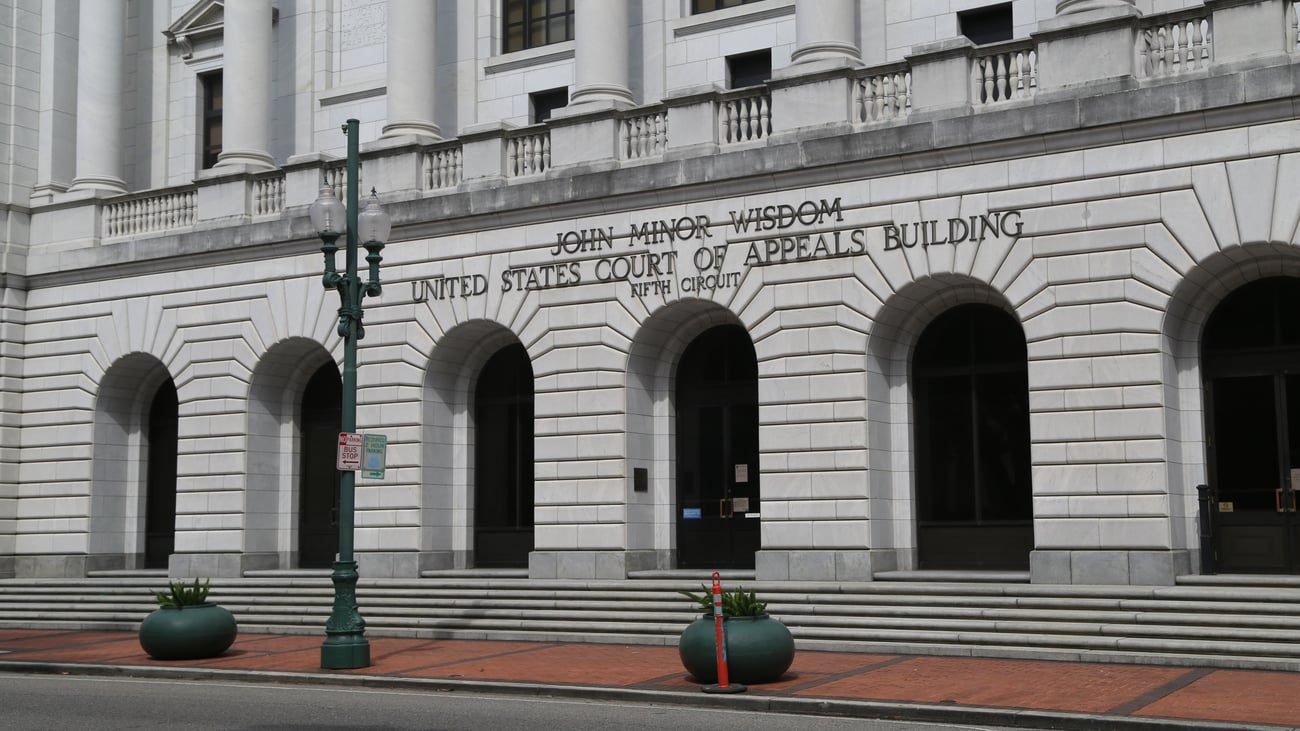
(CN) — A Texas man asked a Fifth Circuit panel Wednesday to vacate his conviction for murdering his ex-fiancée after she accused him of sexual assault, arguing there isn’t enough evidence tying him to the crime for a rational jury to have found him guilty beyond a reasonable doubt.
Robert Udashen, an attorney representing Michael Kevin Adams, told the panel the only evidence directly tying Adams to the crime scene was his touch DNA found on a condom in a wastebasket in the bathroom next to the victim’s bedroom, where she’d been found shot to death.
Udashen argued this evidence isn’t reliable because Adams and the victim previously lived together and touch DNA can transfer between items. He also argued DNA from multiple unknown individuals was also found at the crime scene.
Adams has also argued there is another possible killer, a former Frisco police detective who resigned from the force after he was found to have engaged in inappropriate relationships with several crime victims and witnesses, including Adams’ ex-fiancée.
A witness testified at Adams’ trial he saw a vehicle matching the description of the detective’s personal truck outside the victim’s house on the day of the murder, with a person in the driver’s seat who appeared to be trying to “slink down” to avoid being seen.
Although the detective’s timesheets showed he was working at a school on the day of the murder, Udashen cast doubt on that evidence.
“If you look at the timesheet, which is in evidence, it’s clear that it’s a pre-signed timesheet, it’s dated and signed before a lot of the dates on the timesheet where it claims that he’s working,” Udashen told the panel.
The judges questioned Udashen about the standard of review and deference given to the findings of lower courts, saying he needed to prove no rational jury could have convicted Adams and since this is a federal habeas challenge to a state conviction he had to meet an even higher bar under the Antiterrorism and Effective Death Penalty Act.
“I’ll be honest with you, I do see the force in your argument from the evidence, but how is the argument that you’re making now to this court on federal habeas any different from that argument that would have been made to the jury?” U.S. Circuit Judge Kyle Duncan, a Donald Trump appointee, asked. “I assume that those powerful arguments were made to the jury as a reason to acquit or find not guilty.”
In March 2013, 34-year-old Nichole Leger reported to Frisco, Texas, police Adams had drugged her, sexually assaulted her and tied her up in his garage.
Adams was arrested but was released on bond. Leger moved to Melissa, Texas, to get away from Adams, witnesses said, but in September of that year she was found shot to death in her bedroom.
Adams was charged with killing Leger, with prosecutors arguing he did so in order to keep her from testifying against him in the sexual assault case.
In 2016, a Collin County jury convicted Adams of capital murder, and he was sentenced to life in prison without the possibility of parole.
The conviction was upheld on appeal, although a dissenting judge said the conviction should be vacated because there wasn’t enough evidence to find Adams guilty beyond a reasonable doubt and that a rational jury could have at most a “strong suspicion” Adams committed the murder.
Texas Assistant Attorney General Cara Hanna disagreed Wednesday. Adams and Leger had lived together at a different house more than six months prior to the murder, which she argued reduced the possibility the touch DNA on the condom was due to transference.
She also argued other evidence besides the DNA pointed to Adams being the murderer, such as that days before the murder he had used his work computer to look up the coordinates of Leger’s house.
“Mr. Adams is a stalker, a rapist and a murderer,” Hanna said. “He had everything to lose with his ex-fiancée alive and everything to gain with her dead.”
Judges on the panel pressed Hanna about the sufficiency of the evidence.
“Motive, means and opportunity isn’t evidence that places him at the scene of the crime, is it?” Duncan asked.
U.S. Circuit Judge Cory Wilson, another Trump appointee, said the DNA evidence was “a mess, to put it mildly.”
He pointed out the crime lab analyzed DNA samples from the murder and the sexual assault on the same day, raising the specter of contamination, and that the lab accidentally destroyed other samples in the case.
“That’s quite a muddle to go on to convict a person,” Wilson said.
U.S. Circuit Judge Andrew Oldham, also a Trump appointee, joined Duncan and Wilson on the panel. The judges took the case under submission and did not indicate when they would rule.
Subscribe to our free newsletters
Our weekly newsletter Closing Arguments offers the latest about ongoing trials, major litigation and rulings in courthouses around the U.S. and the world, while the monthly Under the Lights dishes the legal dirt from Hollywood, sports, Big Tech and the arts.