
 Search Articles


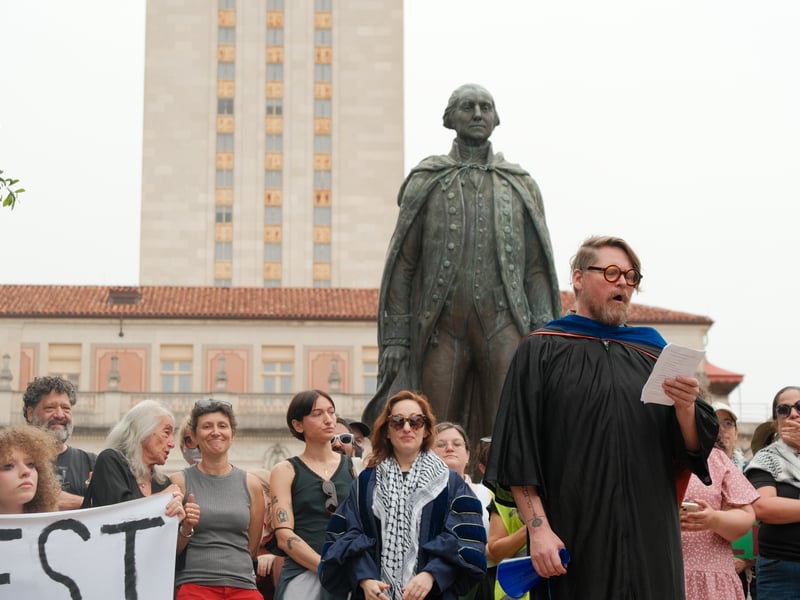
AUSTIN, Texas (CN) — Five student groups in the University of Texas system filed a federal lawsuit Wednesday to block a state law from heavily restricting students’ expressive activities on campus.
Texas lawmakers passed Senate Bill 2972, the “Campus Protection Act,” during the 2025 session in response to the prior summer’s university student protests against Israel’s war in Palestine. Now, student groups argue the law broadly violates their First Amendment rights.
The protests, in Texas and nationwide, demanded universities cut financial ties with Israel or Israeli institutions. Students camped overnight on campus greens, drawing national attention and sharp rebukes from officials. City and state police cleared several encampments and sent in personnel to break them up.
One year later, alongside the Trump administration’s efforts to deport several prominent student activists such as Mahmoud Khalil, state legislatures have begun cracking down hard on campus protests. Bills like Senate Bill 2972 not only ban student encampments but also go much further.
SB 2972 heavily restricts when and how students can engage in expressive activity on campuses. Expressive activity, as defined in a 2019 state law meant to expand students’ free speech protections, “means any speech or expressive conduct protected by the First Amendment to the United States Constitution or by Section 8, Article I, Texas Constitution, and includes assemblies, protests, speeches, the distribution of written material, the carrying of signs and the circulation of petitions.” There is an exception in that 2019 law, however: “The term does not include commercial speech.”
SB 2972 bars expressive activity on campus between 10 p.m. and 8 a.m. and imposes further restrictions during the final two weeks of the semester, including bans on megaphones, speakers, drums during class hours and face coverings during demonstrations.
It also requires students and employees to show documents proving their identity and enrollment or employment if requested by campus police.
Five student groups at the University of Texas at Dallas — including the Fellowship of Christian University Students and the independent student newspaper The Retrograde — argue the law imposes overly broad restrictions and violates their First Amendment rights.
“It would be unconstitutional enough if in passing the Act, Texas targeted only peaceful protest,” the student groups wrote in their lawsuit. But the Act casts a long censorial shadow. Early morning prayer meetings on campus, for example, are now prohibited by law. Students, best beware of donning a political t-shirt during the wrong hours. And they must think twice before inviting a pre-graduation speaker, holding a campus open-mic night to unwind before finals, or even discussing the wrong topic—or discussing almost anything—in their dorms after dark.”
“Simply put,” they continued, the Act transforms Texas’s public universities and colleges into expression-free zones after dark and at the end of academic terms. And the danger to freedom of expression does not end there. The Act’s unbounded speech restrictions give campus officials a potent tool to cudgel most any speech—or speaker—they dislike into silence.”
Under Supreme Court precedent, First Amendment law often involves two kinds of speech restrictions, content-based restrictions and time, place, or manner restrictions. Laws creating content-based restrictions are unlikely to survive a lawsuit, while courts have outlined circumstances where governments can enact time, place, and manner restrictions.
SB 2972’s ban on expressive activity between 10 p.m. and 8 a.m. looks like a time restriction. But the Dallas student groups argue it is also content-based, since the 2019 state law’s definition of expressive activity excludes commercial speech. That means the university can only enforce the time ban by deciding whether speech is commercial or not — a content-based distinction.
The student groups provide a hypothetical example in their lawsuit to demonstrate their argument. “For instance, the Overnight Expression Ban prohibits peacefully holding a sign on campus at 7:00 A.M. protesting world hunger, but does not prohibit holding a sign at 7:00 A.M. promoting a student organization’s bake sale. Likewise, it does not bar a student group from selling Bibles on campus at 10:30 P.M., but it does bar that group from discussing their favorite Bible verses at 10:30 P.M.”
The nonprofit representing the West Texas student group, the Foundation for Individual Rights and Expression, issued a press release Wednesday alongside the lawsuit.
“The First Amendment doesn’t set when the sun goes down,” FIRE senior supervising attorney JT Morris said in the press release. “University students have expressive freedom whether it’s midnight or midday, and Texas can’t just legislate those constitutional protections out of existence.”
Morris also provided his own statement to Courthouse News. “Texas is mandating that its public universities and colleges silence campuses 10 hours a day. Students must now think twice before holding a peaceful candlelight vigil, worshipping at sunrise, or breaking late-night campus news. No one on a public university campus should have to check their watch just to make sure they can exercise core First Amendment rights. Laws like the Campus Protection Act are doubly dangerous to free expression because they provide campus officials a tool to wield at will against disfavored speech. That’s why FIRE is suing to stop the Act from chilling free speech where it should be at a zenith–our institutions of higher education.”
Representatives for the university have not yet responded to a request for comment.
Subscribe to our free newsletters
Our weekly newsletter Closing Arguments offers the latest about ongoing trials, major litigation and rulings in courthouses around the U.S. and the world, while the monthly Under the Lights dishes the legal dirt from Hollywood, sports, Big Tech and the arts.