
 Search Articles


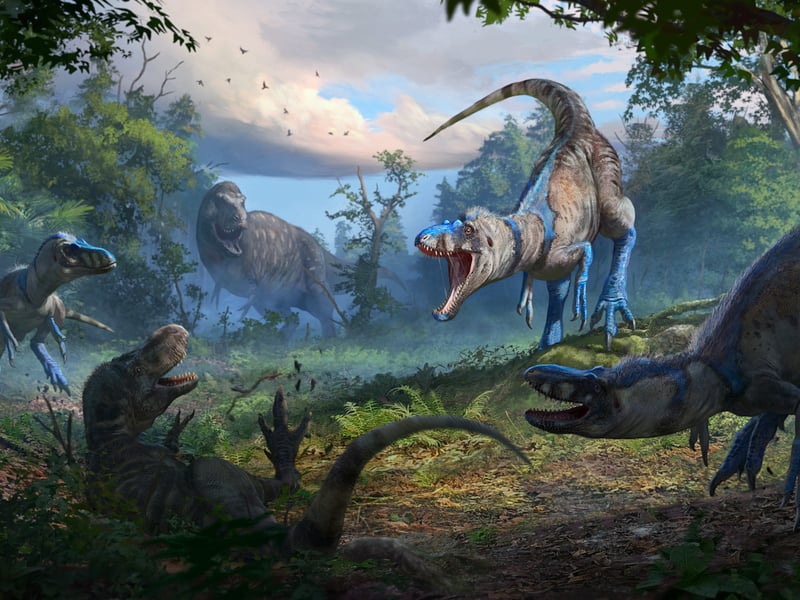
(CN) — A fossil long at the center of one of paleontology’s fiercest debates has finally given up its secret, and it’s rewriting what scientists know about Tyrannosaurus rex.
Researchers studying the famous “Dueling Dinosaurs” fossil, which preserves a Triceratops and a small-bodied tyrannosaur locked in combat, say the smaller predator isn’t a teenage T. rex as once thought, but a fully grown adult of a separate species called Nanotyrannus lancensis.
“This fossil doesn’t just settle the debate. It flips decades of T. rex research on its head,” said Lindsay Zanno, associate research professor at North Carolina State University and head of paleontology at the North Carolina Museum of Natural Sciences, in a press release.
The new analysis, published Thursday in Nature, shows that the specimen, which was around 20 years old when it died, had already reached physical maturity.
Its skeleton tells a different story from any T. rex: larger forelimbs, more teeth, fewer tail vertebrae, and distinct skull nerve patterns, all features that remain fixed through life rather than changing as an animal grows.
“For Nanotyrannus to be a juvenile T. rex, it would need to defy everything we know about vertebrate growth,” said James Napoli, an anatomist at Stony Brook University and co-author of the study, in the press release. “It’s not just unlikely — it’s impossible.”
For decades, scientists have argued over whether small tyrannosaur fossils represented a separate species or were simply young T. rex individuals.
The debate began in the 1940s when paleontologist Charles Gilmore first named Nanotyrannus lancensis from a skull found in Montana.
Later researchers dismissed it as an immature T. rex, arguing that differences were due to growth.
The Dueling Dinosaurs specimen, unearthed in 2006 and now held at the North Carolina Museum of Natural Sciences, provided the first complete skeleton to test that idea.
Using growth ring analysis, spinal fusion data, and comparisons with more than 200 other tyrannosaur fossils, Zanno’s team confirmed that Nanotyrannus was an adult of its own kind.
They also identified a second species, Nanotyrannus lethaeus, named for the River Lethe in Greek mythology, a nod to how the species had remained “forgotten” in museum collections for decades.
Recognizing Nanotyrannus as a distinct genus changes the picture of late Cretaceous ecosystems. Scientists once believed T. rex ruled the landscape uncontested in its final million years before the asteroid impact.
Now, evidence suggests the giant predator shared its territory with smaller, faster relatives.
“This discovery paints a richer, more competitive picture of the last days of the dinosaurs,” Zanno said. “With enormous size, a powerful bite force and stereoscopic vision, T. rex was a formidable predator, but it did not reign uncontested. Darting alongside was Nanotyrannus — a leaner, swifter and more agile hunter.”
The finding also forces a reevaluation of decades of research based on misidentified fossils. Many studies on T. rex growth, feeding behavior and biomechanics relied on specimens now known to belong to Nanotyrannus.
Confirming Nanotyrannus’ existence means predator diversity in the last stretch of the Cretaceous was far higher than previously thought. It also raises the possibility that other small-bodied dinosaurs once written off as juveniles could represent undiscovered species.
“This discovery adds a new dimension to our understanding of tyrannosaur evolution,” Napoli said. “We can now say with confidence that multiple species of tyrannosaur coexisted near the end of the age of dinosaurs.”
The Dueling Dinosaurs fossil, now on display in Raleigh, N.C., remains one of the most complete dinosaur specimens ever found.
Researchers say it captures a rare and intimate moment of two ancient giants frozen mid-battle.
“We’ve never had a window like this into the life and death of these animals,” Zanno said. “It’s a reminder that even after a century of digging, the age of dinosaur discovery is far from over.”
Subscribe to our free newsletters
Our weekly newsletter Closing Arguments offers the latest about ongoing trials, major litigation and rulings in courthouses around the U.S. and the world, while the monthly Under the Lights dishes the legal dirt from Hollywood, sports, Big Tech and the arts.