
 Search Articles


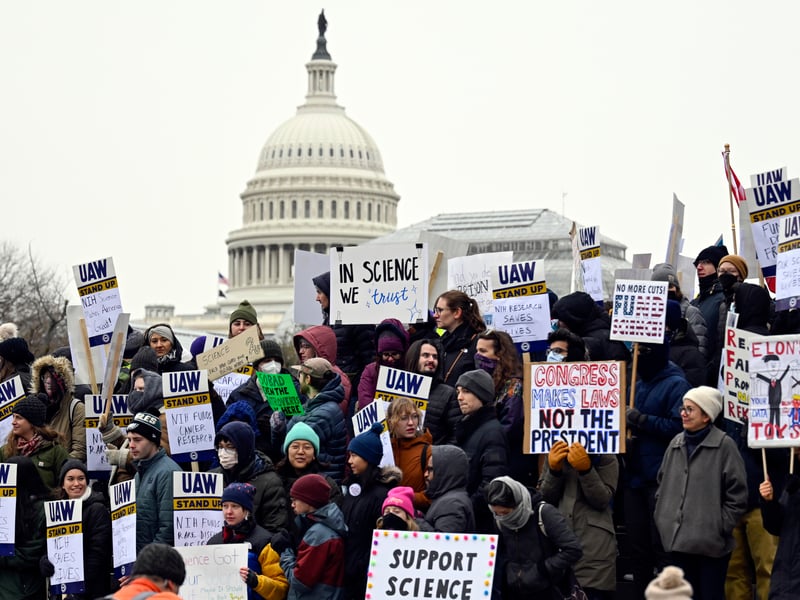
BOSTON (CN) — A First Circuit panel noted in Wednesday arguments over President Donald Trump’s effort to limit how much universities that receive medical research grants from the National Institutes of Health get paid for their overhead expenses that a Trump first-term attempt at such a cap resulted in a congressional roadblock.
Congress “put the kibosh" on an attempted 10% cap in 2017 with an appropriations rider that banned the NIH from changing its overhead rules, Paul Clement of Washington-based firm Clement & Murphy said, representing universities suing the administration.
U.S. Circuit Judge Kermit Lipez seemed to agree, telling government attorney Jennifer Utrecht the rider “puts you at odds with how the regulatory scheme applies here."
“The first sentence of the rider tells the agency that its regulatory provisions can’t be changed,” but now they’ve been “dramatically modified” the judge said.
Utrecht responded that “the proper way to read the rider is Congress was telling the agency to follow its regulations," adding that “the regulations plainly contemplate deviations for entire classes of awards.”
“We can move money around as long as we spend the same amount of money,” she said.
“Even the most textualist of textualists on the Supreme Court wouldn’t agree with that,” Clement said. “Nobody had any doubt in 2017 what this rider did.”
The NIH spends more than $35 billion a year on research grants — an amount that includes not just the direct cost of research but also payments to educational institutions for their overhead, such as building depreciation, debt service and maintenance and accounting.
Many private foundations that make research grants don’t contribute anything to overhead, and those that do typically reimburse at a rate of 10 to 15% of the underlying grant amount. But the NIH’s average overhead rate is more than 27%, and some institutions get far more — Harvard’s rate is 69%.
In February, the NIH announced in a “supplemental guidance” that going forward it would cap overhead payments at 15% — a move expected to save about $4 billion a year that the government claims will be used for more direct grants. A coalition of states and universities sued, and they won an injunction against the lower limits in March.
On Wednesday, Clement described the 15% cap as “crazy.”
“We’re getting 70% and you’re putting us down to 15% and you can’t defend 15% as an approximation of our costs,” he said.
U.S. Circuit Judge Julie Rikelman, a Joe Biden appointee, questioned if the NIH was really spending the same amount of money, inasmuch as the agency issued a social media post in February claiming that it had achieved a $4 billion cost savings.
“Context is often lost in social media posts,” Utrecht said. “That money is going to be spent. The policy controls here, not a tweet.”
Lipez, a Bill Clinton appointee, said the supplemental guidance “invokes stewardship of public funds and comparisons to private foundations. What latitude do we as a court have in exploring those rationales? If they seem reasonable, is that good enough, or can we probe in some depth how reasonable they really are?”
David C. Kravitz of the Massachusetts attorney general’s office, representing the states, said the guidance was faulty because it didn’t consider the universities’ reliance interests.
But Utrecht countered that those interests were limited because longstanding regulations allow the NIH to renegotiate ongoing grants.
“They acknowledge reliance interests,” Lipez said. “This only applies going forward. They say they won’t try to recoup past costs. Isn’t that an acknowledgement?”
“No,” Kravitz answered. “There’s nothing about the effect on universities. There’s no recognition that this allows universities to create the environment that allows scientists to do what they do.”
He added, “Scientists cannot do science if they don’t have laboratories in which to do it.”
Utrecht also argued the lower court that blocked the caps lacked jurisdiction over the case. The grants are contracts, the plaintiffs were bringing contract claims against the government, and therefore they should have gone to the Court of Federal Claims, she told the panel.
“The plaintiffs have no statutory or regulatory right to any money,” she said. “It’s the contract that gives them any rights at all.”
“If the relief is specific performance, then why isn’t that right?” U.S. Circuit Judge Jeffrey Howard asked Clement.
“The relief isn’t specific performance, it’s vacatur of the supplemental guidance,” Clement said. “A damages remedy in the Court of Federal Claims doesn’t begin to be an adequate remedy.”
Clement served as U.S. Solicitor General under President George W. Bush, who also appointed Howard to the appeals court.
Rikelman seemed troubled by the jurisdictional question, suggesting that recent Supreme Court cases were anything but clear. The panel gave little indication at oral argument as to which way they were leaning on either issue.
Subscribe to our free newsletters
Our weekly newsletter Closing Arguments offers the latest about ongoing trials, major litigation and rulings in courthouses around the U.S. and the world, while the monthly Under the Lights dishes the legal dirt from Hollywood, sports, Big Tech and the arts.