
 Search Articles


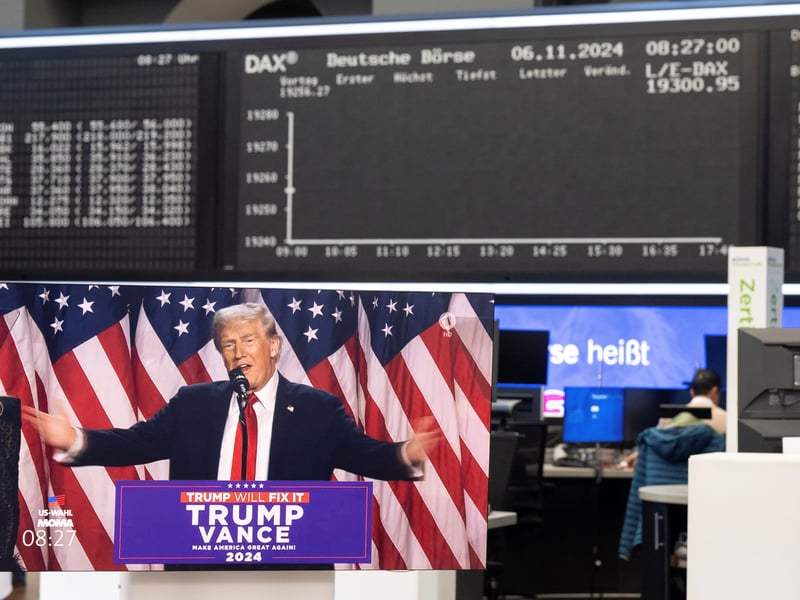
(CN) — Alongside a deep rift between U.S. President Donald Trump and Europe over the conflict in Ukraine and NATO, the risk of a sprawling and deeply damaging transatlantic trade war looms on the horizon.
Already, Trump has slapped duties on imports of steel and aluminum from around the world and he’s talked about hitting the European Union with more tariffs, a move that menaces the 80-year-old transatlantic alliance.
On Wednesday, as his cabinet met for the first time, he made his strongest threat yet against the EU, saying it would be hit with 25% tariffs.
“We have made a decision and we’ll be announcing it very soon. It’ll be 25%,” he said. He accused the EU of unfairly blocking American goods, such as automobiles. Brussels vowed to hit back “firmly and immediately” to “unjustified” trade barriers.
Economists, experts, policymakers and political leaders are baffled and alarmed by Trump’s protectionist economic policies that threaten to dump sand into the gears of international commerce and stifle global trade.
Dismissing what some call “voodoo economics,” most experts say Trump is disastrously wrong in placing faith in tariffs to revitalize American manufacturing and remedy America’s massive and unparalleled trade deficit, which reached $918 billion in 2024, according to U.S. data. Trump has even said the word “tariff” is one of his favorites, right after “God, religion and love.”
“It’s a real risk,” said Mark Vail, a political economist and Europe expert at Wake Forest University, about a trade war between the U.S. and Europe.
‘End of the system’
Since taking office on Jan. 20, Trump has rattled world markets with his tariffs policy and he’s promising to go even further. Before Wednesday’s announcement, experts said they wouldn’t be surprised if Trump announced sweeping import duties against both the EU and China.
The fear is this could trigger a downward spiral similar to what happened in the late 1920s and 1930s when a slew of tariffs contributed to the Great Depression. Back then, governments imposed duties in the hope they would offset the economic downturn. Instead, global trade dropped precipitously and inflicted serious damage around the world.
“It’s unprecedented in the post-war era at this scale and in the boldness of the instrument,” Vail said about Trump’s tariffs threat.
Wolfango Piccoli, a London-based analyst with Teneo, a political risk firm, said, “It’s not the end of globalization, but it’s the end of the system that has somewhat provided a certain sense of stability since the end of the Second World War.”
That post-war system regulating international money flows and trade was constructed largely by the U.S. and paradoxically is now being upended by Washington. It depends on rules and policies governed by the World Bank, the International Monetary Fund and the World Trade Organization.
“There is structural change here where suddenly the country that has provided a sense of stability, not just in terms of security but in terms of trade, in terms of the economic front, is becoming the main source of uncertainty,” Piccoli said. “The norms that we were taking for granted until recently, now they’re all questionable.”
This is particularly disorienting for the EU because it is, by its very nature as a supranational entity, organized around adherence to common rules and norms, multilateralism, free trade and mutual respect, Piccoli said. “It’s a big shift here.”
But in Trump’s worldview, that post-war system was unfair to the U.S. and he’s ready to ditch it all.
‘Investment, not trade’
For both Europe and the U.S., much is at stake.
The trade relationship between the EU and the U.S. is the largest in the world, standing at about 1.5 trillion euros ($1.55 trillion) in 2023 when both goods and services are combined, according to EU figures.
But the EU sends far more goods — cars, machines, wine, bicycles, pharmaceuticals and more — to the U.S. than it imports from America, and that is Trump’s main bone of contention. In 2024, the EU had a goods surplus worth about $235.6 billion, according to data from the U.S. Census Bureau.
However, the trade deficit shrank to $125 billion in 2023 when services, including financial, technological, legal, accounting and engineering work, were taken into consideration, U.S. data shows. The U.S. had a $76.5 billion surplus when it came to services sold in the EU, U.S. figures show.
Added to that are huge investments European and American companies have made in each other’s markets, amounting to more than $5 trillion.
“Trump’s decision to look at the U.S.-European relationship based on trade is fundamentally flawed,” said Peter Chase, a former U.S. diplomat and trade expert at the German Marshall Fund, a Washington-based think tank dedicated to fostering transatlantic ties. “The U.S.-EU economic relationship is based on investment, not on trade.”
American companies have invested about $2.6 trillion in the EU and EU companies have sunk about $2.4 trillion into the U.S. Indeed, more than half of U.S.-EU trade involves companies sending goods back and forth across the Atlantic Ocean, so-called intra-company trade, U.S. data shows.
“It’s Siemens Europe exporting to Siemens U.S.,” Chase said. “GE U.S. exporting to GE Europe.”
Tariffs, then, would naturally make this flow of goods more expensive too.
Job losses for US, EU?
“Anything he does that affects trade between the United States and Europe is going to affect American firms and American workers,” Chase said. “The idea of making Europe ‘pay’ by levying tariffs on products coming from Europe to the United States is actually going to be a major problem for autoworkers in the South. That just doesn’t make sense.”
For example, German automaker BMW makes many of its X-series sport utility vehicles and sporty coupes at a major factory in Spartanburg, South Carolina, and then exports them around the world, including back to Europe.
Chase added that millions of Americans “are employed in the distribution and finalizing and use of imported products” and tariffs threaten those livelihoods. “You get rid of a lot of imports, you get rid of a lot of jobs,” he said.
Trump’s aversion to free trade may cause massive harm to American businesses, he said.
“Ninety-five percent of the world’s consumers are outside the United States,” Chase said. “And 90% of the world’s consumption power, consuming power, is outside the United States. If you want U.S. companies to shrivel up, cut them off from international markets.”
But it’s Europe that arguably risks the most from a trade war with the U.S. because its prosperity has been built on exports.
This can be traced back to how Europe rebuilt after World War II. In the wake of the war, Europe was a collection of war-ravaged nations with small domestic markets and exports were seen as a solution.
“To grow economically rapidly, they couldn’t really focus solely on domestic sales,” Vail said. “They had to be open to the rest of the world and had to find export niches in which they could be competitive.”
Germany epitomized this strategy. Its big manufacturers of chemicals, automobiles, machinery and other goods began looking overseas for buyers and toward America in particular.
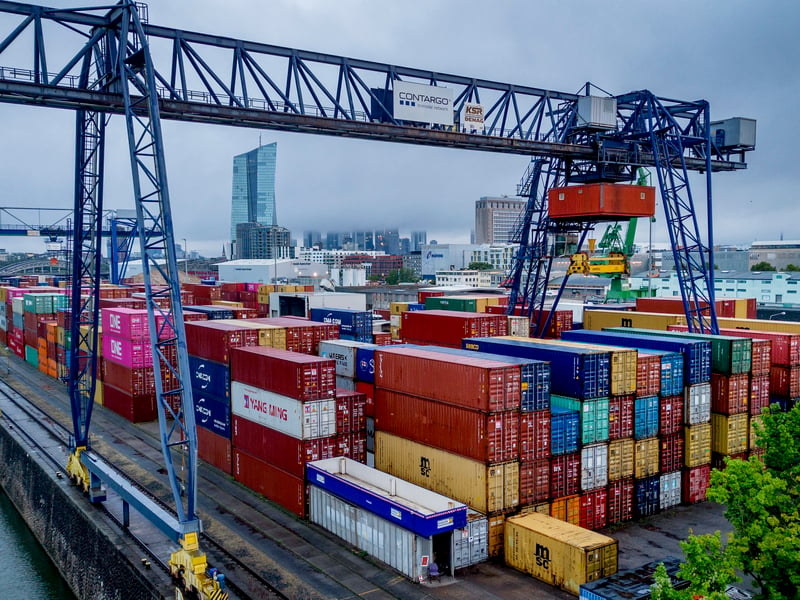
“By the early 1960s, Germany was one of the largest exporters in the world,” Vail said.
To remain competitive overseas, Germany also took a series of steps to make this happen: It kept wages low, inflation in check and spending and public debt under control.
“It’s been very interested in balanced budgets or limited debts and deficits,” Vail said.
This model turned out to be highly successful: There has long been great demand for Germany’s high-end products, and the country has become one of the world’s leading exporters.
“Once you have institutions invested in this particular economic strategy, it’s kind of hard to unring that bell,” Vail said. “You can’t just flick it off like a light switch.”
But this model was already under stress before Trump’s ascendancy due to slowing demand in China, a chief market for Germany, and rising manufacturing costs caused by higher energy prices after Europe cut off Russian natural gas supplies.
“American tariffs point a dagger at the heart of the export model of countries like Germany,” Vail said.
It’s not only manufacturing at risk in Europe. Farmers too face trouble from a tariffs war due to Europe’s large trade surplus in agricultural products with the U.S. Trump likes to complain about Europe’s protectionist agricultural policies.
EU assesses its options
If a trade war breaks out, the EU may seek to hurt the U.S. by targeting its financial and technological services, America’s prime exports to Europe. One possibility would be to limit the use of U.S. intellectual property rights in the EU. A large part of America’s services trade surplus stems from royalty payments on technological patents and copyrighted movies, music and other entertainment consumed in Europe.
But questions abound whether the EU’s 27 member states would agree on how to confront the U.S. as a united bloc. Should the EU become bogged down by squabbles and inaction, individual countries might be tempted to go it alone and win exemptions from the U.S., an outcome that would weaken the EU’s hand.
Vail said the EU often is hobbled by disagreement among its members when it comes to adopting common trade policies. Also, the EU’s complex rules can be a hindrance. “They have an incredibly Byzantine and opaque bureaucracy that deals with these things,” he said. “They tend to be very slow. They tend to be very cumbersome and they’re not great at short-term reactions to policy crises.”
Another question is whether Europe would be willing to blow up the old post-war playbook and go rogue like Trump.
“Trump makes no bones about breaking conventional understandings of international law and breaching treaties,” Vail said.
The EU may be constrained by its law-abiding instincts.
“That creates a kind of asymmetry in the relationship,” Vail said. “The burden for them is really on those who wish to make a case for breaking them; whereas for Trump, the burden of proof is on those who wish to make a case for abiding by them.”
There’s another possible outcome too: Trump may end up shelving his tariffs due to the damage they might cause the American economy.
“Tariffs are a very blunt instrument and they often have a lot of unintended consequences,” Vail said. “In six months or a year, if all of this actually does get implemented, I think people are going to be quite surprised at the inflationary effects and I think there’s likely to be some political blowback that many in the administration aren’t anticipating.”
Courthouse News reporter Cain Burdeau is based in the European Union.
 Follow @cainburdeau
Subscribe to our free newsletters
Our weekly newsletter Closing Arguments offers the latest about ongoing trials, major litigation and rulings in courthouses around the U.S. and the world, while the monthly Under the Lights dishes the legal dirt from Hollywood, sports, Big Tech and the arts.