Search Articles


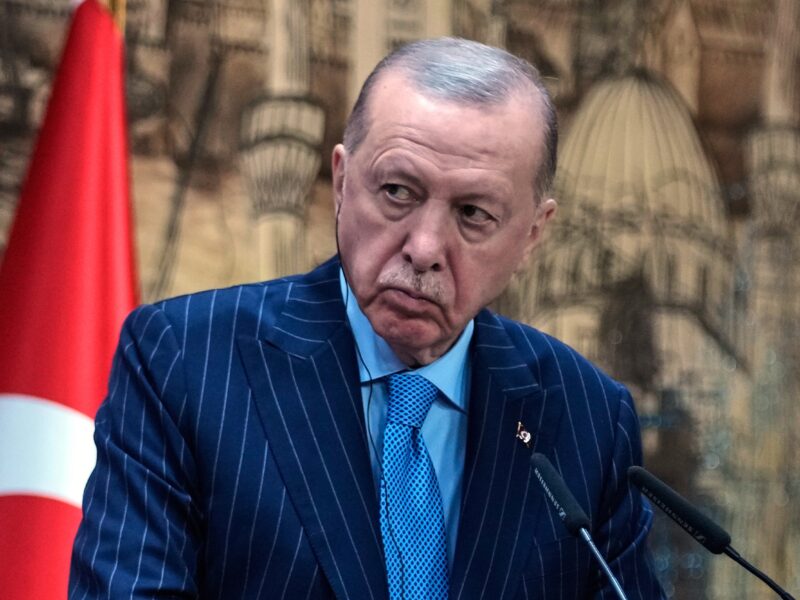
(CN) — Journalists, lawyers, activists and left-wing critics were among hundreds of people arrested in Turkey during the lead-up to a NATO summit this week hosted by Turkish President Recep Tayyip Erdoğan.
The wave of arrests by Erdoğan’s authoritarian government elicited almost no criticism from Western capitals, a response reflecting Turkey’s growing military and geopolitical importance for NATO, especially for European members pushing to rearm themselves to counter Russia.
“Everybody wants Turkey inside NATO and if you want Turkey in NATO, you don’t try to cross Erdoğan on what he’s doing internally,” said Scott Lucas, a professor of international politics at University College Dublin. “Erdoğan has been ruling as an authoritarian for quite some time.”
Under tight security and a ban on protests, Erdoğan was set to host two days of NATO talks at his presidential palace in Ankara on Tuesday and Wednesday.
The high-stakes discussions promised to be dominated by U.S. President Donald Trump, who’s kept allies on edge by talking about withdrawing U.S. troops from Europe and not living up to NATO’s mutual defense principle. Trump was expected to hold a news conference on Wednesday before returning to Washington.
This is only the second time Turkey has hosted a NATO summit, the last one taking place in 2004 when Erdoğan, then serving as prime minister, welcomed former U.S. President George W. Bush. That summit was marked by daily protests against NATO and the U.S.-led invasion of Afghanistan.
A NATO member since 1952, Turkey possesses the alliance’s second-strongest army and its military capacity has grown under Erdoğan, who has wielded power since 2003. Highlighting Turkey’s military industrial might and innovations will take a central role at the summit.
Still, this NATO meeting brought into relief Erdoğan’s authoritarian rule and his government’s attacks on his chief political rival, the Republican People’s Party, or CHP, Turkey’s oldest political party.
In March 2025, police arrested Istanbul Mayor Ekrem İmamoğlu, a leading CHP figure, on charges that are widely viewed as bogus. After 470 days, İmamoğlu remains in prison awaiting trial.
Meanwhile, scores of CHP officials, including numerous mayors, have been arrested. Erdoğan also is accused of seeking to seize control of the CHP’s internal workings.
In May, a court ousted Özgür Özel, the party’s leader, after declaring internal 2023 elections null. His defeated rival Kemal Kılıçdaroğlu was ordered to resume his position as CHP leader, leaving the party in chaos. Human Rights Watch called the court order a “deeply damaging blow to the rule of law, democracy and human rights.”
“Since İmamoğlu’s arrest, we’ve watched a systematic dismantling of the opposition’s institutional base,” said Begum Zorlu, an expert on Turkish politics at City, University of London.
“We are passing through contentious times,” she added. “There is resistance to this crackdown but also as the resistance increases so does the repression.”
The NATO summit has given Erdoğan more excuses to crack down on his opponents, critics say.
Over the past two weeks, more than 300 people have been arrested, according to news reports and human rights groups. A fresh round of arrests was reported over the weekend.
Arrests were linked to anti-NATO and anti-government protests led by the Communist Party of Turkey, but security forces also have targeted people in their homes during early morning raids.
Prosecutors said police operations targeted suspected members of the so-called Islamic State and the Revolutionary People’s Liberation Party/Front (DHKP-C), a communist group designated a terrorist organization by Turkey.
“In the run-up to the NATO summit, what we’re seeing, I believe, is no longer a single crackdown but a rolling one,” Zorlu said in an email.
Among those arrested for their supposed links to terrorism were political activists, environmentalists, a journalist and an LGBTQ+ rights activist, Yıldız Tar, Zorlu said.
They “were all swept up under anti-terror framing without much specificity about actual alleged conduct,” she said. “The net of ’terrorist’ affiliations cited was remarkably broad.”
Over the weekend, Turkish authorities detained about 145 people at anti-NATO demonstrations organized by the Communist Party of Turkey.
Meanwhile, journalists, academics, lawyers, activists, labor unionists and left-wing organizers in Ankara, Istanbul, and other provinces have been swept up in raids.
“The pattern suggested not a single isolated operation, but an escalating sequence of detentions continuing right up to the summit’s opening,” Zorlu said.
She called the arrest of journalists “another blow to press freedom” following the recent arrest of Deniz Göktaş, a well-known stand-up comedian. He was detained at Istanbul’s main airport for satire deemed insulting to Erdoğan and to religious values.
Turkey’s representative for Reporters Without Borders, Erol Onderoglu, condemned the “blind, arbitrary and haphazard operations” that endangered “the reputation and safety of journalists,” as reported by AFP, a French news agency.
Zorlu said the wave of arrests “demonstrates that the ruling party does fear a democratic political competition process.”
Still, she said Erdoğan seems to believe that the public discontent stirred up by his crackdown on opponents is “manageable.”
“Opposition figures are still able to mobilize this indignation, but without the level of sustained street pressure seen after İmamoğlu’s arrest in 2025,” she said. “So, I do not believe that this is destabilizing for the regime in the short term.”
Courthouse News reporter Cain Burdeau is based in the European Union.
 Follow @cainburdeau
Subscribe to our free newsletters
Our weekly newsletter Closing Arguments offers the latest about ongoing trials, major litigation and rulings in courthouses around the U.S. and the world, while the monthly Under the Lights dishes the legal dirt from Hollywood, sports, Big Tech and the arts.