
 Search Articles


MANCHESTER, England (CN) — Even as a fragile ceasefire takes hold in the Middle East and crude oil prices plunge Wednesday, Britain is bracing for higher household energy bills, with energy experts urging demand cuts as the government offers little immediate relief.
The U.S.-Israel war with Iran has choked key shipping routes through the Strait of Hormuz, one of the world’s most important energy corridors, sending wholesale gas prices sharply upward.
Prices remain higher than pre-war levels, and experts warn that even if the U.S.-Israeli-Iranian ceasefire holds, it could take months before disrupted energy supplies return to normal.
Analysts now expect the next U.K. energy price cap, due in July, to rise by as much as $400 a year for a typical household.
The current energy cap, which is set at approximately $2,200, was announced before the Iran conflict.
The government has urged calm. Chancellor Rachel Reeves said support may come for lower-income households if high prices persist, but ruled out immediate, broad relief.
That approach contrasts with other countries that moved quickly to cut demand or cushion consumers.
Germany has revived public campaigns urging households to lower energy use, while France has capped price increases and is offering loans to small businesses hit hardest by rising fuel costs, including those in transport, fishing and agriculture.
In the U.S., the federal government has focused on boosting domestic oil and gas production rather than encouraging demand reduction.
The gap raises questions about how exposed the U.K. is to global shocks, and whether its response leaves households vulnerable when prices climb again.
U.K. overexposed to global events
Britain’s energy system is tightly linked to international markets.
Domestic gas production meets only about half of demand, with the rest imported, while oil prices track global benchmarks.
“The U.K. has an open market-based energy system,” said Mike Bradshaw, a professor of global energy at the University of Warwick. “Domestic policy cannot change this situation, exposing U.K. customers to rising global prices. For example, putting a cap on gas prices would simply mean that LNG [liquid natural gas] would go elsewhere, creating a domestic physical shortage of gas.”
The International Energy Agency said the conflict caused one of the largest disruptions in oil supply in history and cut global liquefied natural gas supply by about 20%.
Member countries released 400 million barrels of oil from emergency reserves in March to stabilize markets. The agency has also advised governments to reduce highway speeds and encouraged workers to carpool or work from home.
Even before the conflict, Britain’s reliance on imports was rising.
Government data shows net import dependency climbed to 43.8% in 2024, up from 40.3% the year before.
That growing exposure is feeding a political divide over how to respond, not only to this crisis but to future ones.
Drill deeper or accelerate renewables?
The current government has banned new exploration of oil fields, allowing only existing licenses as well as fields in close proximity to existing infrastructure.
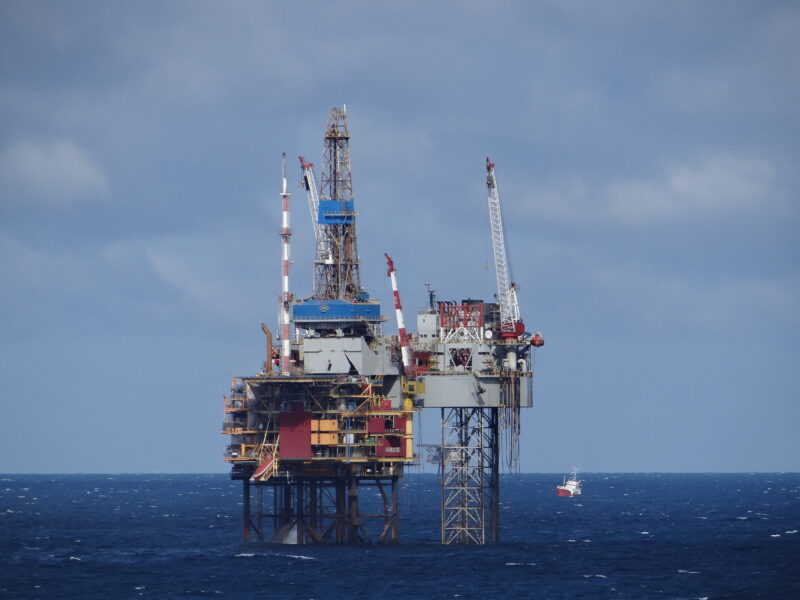
Right-wing lawmakers and commentators have called for expanded drilling in the North Sea, off the coast of eastern Scotland, arguing it would improve energy independence.
Some on the left say the answer lies in accelerating renewable energy and cutting fossil fuel demand.
Bradshaw said more drilling would have limited impact.
The area “is a mature basin, well past peak production and in terminal decline,” he said. “Thus, new drilling would at best slow the rate of decline.
“A modest increase in production would not influence the price, though, on the margins, it might reduce the amount of gas imported,” he said.
Bradshaw called this a pragmatic approach.
“A new round of exploration is unlikely to make any difference … . An approach that makes the most of what we have while preparing for a future without U.K. oil and gas production makes sense and is compatible with the country’s climate targets,” he added.
A hands-off approach
Jan Rosenow, a professor of energy and climate policy at the University of Oxford, said the government has underused simple measures that could lower bills quickly.
A public information campaign, like those used in Germany and the Netherlands previously, could cut household demand by up to 15%, he said.
“Beyond that, emergency funding to scale up draft-proofing and insulation for the lowest-income households could deliver bill savings within months, not years. Time-of-use tariff incentives that reward households for shifting consumption away from peak periods are another underused lever.”
However, he said “The U.K. has historically prioritized ensuring supply to meet demand, rather than adopting proactive, coordinated policies to reduce demand, which has often been overlooked in policy strategies. One of the reasons for this is a reluctance to interfere with how people use energy in their own homes.”
This has meant ministers have avoided telling people how to use energy at home, a political choice that sets Britain apart from some European neighbors.
For households, the impact is already clear.
A More In Common survey shows concern over energy bills has risen sharply, with 73% of Britons now citing them as a top cost-of-living issue. Two in five say energy costs have caused arguments at home.
Penelope, a resident of Birmingham, said she is forced to make difficult choices.
“The bill is going higher and higher,” she told More In Common. “It’s either heat or food. You can’t do both. Well, I can’t.”
Tom from Stoke said he used to switch all the plug sockets off in the house, but now even unplugs the sockets to avoid using electricity. “You shouldn’t have to live like that,” he said.
Experts warn that Britain risks repeating the pattern seen after Russia’s invasion of Ukraine, when global shocks quickly translated into higher domestic bills.
Accelerating the transition
Longer term, Rosenow said cutting reliance on fossil fuels is key.
“The potential for reducing energy demand is huge. Replacing gas boilers with highly-efficient heat pumps and better insulation can reduce household energy consumption by more than 60%,” he said. “This is far more effective in the long term than new drilling. We will need more renewables to power the switch from burning fossil fuels to heat pumps in homes and also to replace gas fired power plants.”
Bradshaw recommends an “all-of-the-above” approach.
“The current debate is polarized with some seeing net-zero policies as the problem and others as the solution,” said Bradshaw.
He calls for the acceleration toward the low-carbon transition, adding more wind and solar power while solving grid congestion.“There is also a continuing role for natural gas, primarily as a source of flexibility and inter-seasonal storage, though it may have to cover for falling nuclear power.”
That, however, will take time, leaving millions of households exposed to high costs, and with a government reluctant to intervene.
Courthouse News reporter James Francis Whitehead is based in England.
 Follow @jayfranklinlive
Subscribe to our free newsletters
Our weekly newsletter Closing Arguments offers the latest about ongoing trials, major litigation and rulings in courthouses around the U.S. and the world, while the monthly Under the Lights dishes the legal dirt from Hollywood, sports, Big Tech and the arts.
Additional Reads
 Greece to ban social media for under 15-year-olds April 8, 2026
 EU exhales as Trump pulls back from the brink, for now April 8, 2026
 Researchers unmask trade in nude images on Telegram April 8, 2026