
 Search Articles


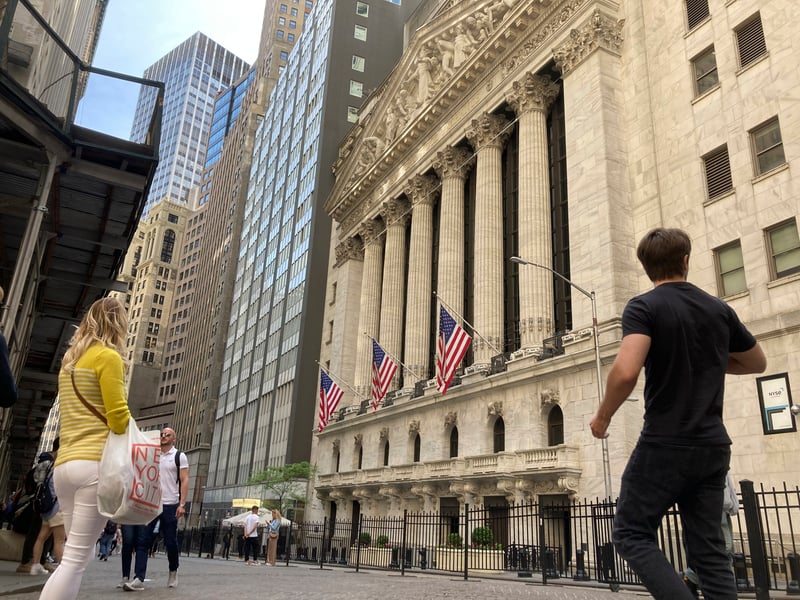
MANHATTAN (CN) — With both Wall Street and Main Street unsure where the Trump administration will settle on tariffs, U.S. equities had one of its worst weeks in months.
On Monday, markets plunged after President Donald Trump announced 25% across-the-board tariffs for goods from Canada and Mexico, as well as an additional 10% tariff on Chinese goods. The Dow Jones Industrial Average lost more than 1,300 points in two days.
Following the rout, the Trump administration quickly backed off and announced a one-month carveout for domestic automakers. However, investors were not able to claw back those losses, and the bleeding continued throughout the week on mixed messaging from the White House.
By the closing bell Friday the Dow had lost 1,039 points for the week. The S&P 500 and Nasdaq had similarly miserable outings, shedding 184 points and 651 points, respectively.
Investors and analysts are not yet predicting a recession, though. “Although our forecast for first-quarter GDP growth is now down to -1.9% annualized, we still believe that, on balance, the U.S. economy will escape recession and rebound in the second quarter,” Paul Ashworth, chief North America economist, wrote in an investor’s note on Thursday.
The federal jobs report on Friday also points to a slowdown but not an outright recession, with just 151,000 jobs added last month. Charlie Ripley, senior investment strategist for Allianz Investment Management, said in a statement that “the U.S. economy is indeed slowing on the margin, but more importantly we are not seeing the economy fall off a cliff.”
Ripley noted the Federal Reserve will likely use the jobs data to “sit on the sidelines” for the next few months to assess potential inflation from Trump’s tariff policy.
The Federal Reserve’s latest Beige Book, which tracks economic growth from the central bank’s regions, found expectations for economic activity in the coming months was largely optimistic.
Fed Chair Jerome Powell also said in a Friday speech the central bank will be watching the president’s policy changes on immigration, tariffs, taxes, and regulation. “We do not need to be in a hurry and are well positioned to wait for greater clarity,” he said.
Other economic data paint a muddled picture of the economy. On the one hand, manufacturing prices have jumped to their highest point since June 2022, according to the latest ISM Manufacturing “prices paid” index. The “new orders” index also fell several points to the same area as last seen in mid-2022.
However, employment increased last month, according to ISM, and new orders in the ISM Services index were relatively unaffected by uncertainty over tariffs, increasing by just under one point after falling more than 3 points last month.
Abroad, the European Central Bank cut interest rates again by a quarter point this week to bring them down to 2.5%. However, ECB officials have noted that recent policy decisions by member states have added uncertainty to economic growth. ECB President Christine Lagarde reportedly said after the announcement that “from one day to the other, the situation changes dramatically.”
 Follow @NickRummell
Subscribe to our free newsletters
Our weekly newsletter Closing Arguments offers the latest about ongoing trials, major litigation and rulings in courthouses around the U.S. and the world, while the monthly Under the Lights dishes the legal dirt from Hollywood, sports, Big Tech and the arts.