
 Search Articles


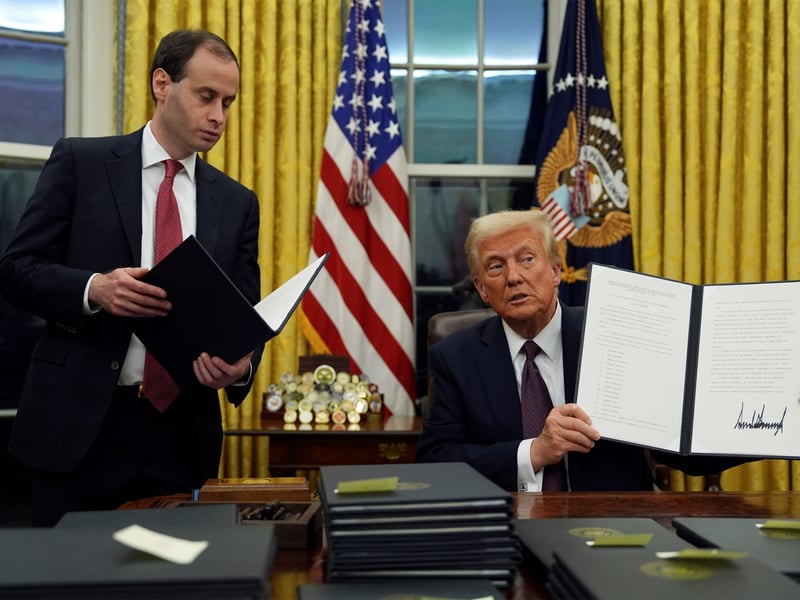
WASHINGTON (CN) — President Donald Trump’s executive order palooza is already facing legal battles that could slow-walk some of the administration’s new policies, but the Supreme Court was already primed to weigh in on key goals like transgender rights and workplace discrimination.
Within hours of retaking office, Trump issued a slew of orders targeting transgender rights, declaring that the United States only recognizes two sexes which are not changeable.
“Ultimately, what this executive order is trying to do is to obfuscate the reality that transgender people exist,” Cathryn Oakley, the senior director of legal policy at the Human Rights Campaign, said.
The order titled “defending women from gender ideology extremism and restoring biological truth to the federal government” instructs federal agencies to retract documents using the term gender instead of sex. This includes government-issued identification documents like passports.
Transgender people are now barred from single-sex spaces like bathrooms. Oakley said the administration could face lawsuits for trying to take away abilities, dignities or rights from a certain group of people, which is prohibited by the equal protection clause of the 14th Amendment.
The Supreme Court heard argumentsunder one avenue of potential litigation in December: gender-affirming care for transgender kids. Civil rights groups representing Tennessee families and doctors want the justices to find that a state law only prohibiting transgender children from receiving hormone therapy violated equal protection.
The Biden administration sided with the families, but the Trump administration could submit a conflicting argument.
“I expect that we’ll hear from them in relatively short order on the docket about a potential change in position,” Chase Strangio, co-director of the ACLU’s LGBTQ & HIV project, told reporters.
Strangio became the first openly transgender lawyer to argue at the Supreme Court when he represented families fighting Tennessee’s ban.
The executive order provided little guidance on what arguments the Trump administration could submit to the justices. Neither the Justice Department nor the White House responded to requests for comment on potential filings.
Even if the government flips positions to favor Tennessee, however, the private plaintiffs represented by the ACLU and Lamba Legal still have a live case before the justices.
The justices aren’t expected to rule on the case until the end of their term in June, but how the ruling comes down will put a thumb on the scale for the future of transgender rights.
“To the extent the decision in U.S. v. Skrmetti clarifies some aspect about the constitutional protections that trans people enjoy, then that will guide to an extent the ways in which any of these actions are litigated under the Constitution,” Strangio said.
Trump characterized the advancement of transgender rights as “eradicating the biological reality of sex.” Court watchers say this definition conflicts with decades of sex discrimination case law.
“Their intention around doing that is to erase the existence of transgender folks, and also to take for those of us who are not transgender, including myself, to take our personhood and limit that to our reproductive capacity,” Oakley said.
Trump’s executive orders also called for an overhaul of workplace discrimination policies. Diversity, equity and inclusion, known as DEI, programs have come under fire from conservatives who view them as giving preference to minorities.
In 2023, the Supreme Court gutted affirmative action policies used by universities, endorsing the view of a “colorblind Constitution.” Trump echoed that reasoning to root out DEI programs in the public and private sectors by revoking decades of executive policy on workforce equality.
Often consternation over DEI programs surrounds advantaging one group over another based solely on race, gender or other protected qualities. However, employment experts say considering an applicant’s race in a hiring decision is already unlawful.
Margaret Zhang, an assistant professor at Widener University Delaware Law School, said as a university DEI professional, her work is concerned with leveling the playing field for candidates, like providing accessibility options for people with disabilities.
“We were trying to make sure that people from all different backgrounds have the ability even to interview and be considered for various things at work,” Zhang said.
Because racial discrimination is already illegal, Trump’s anti-DEI order largely doesn’t shift policy. It could, however, lead to more workplace discrimination claims.
“They might say, for instance, that the DEI efforts at my workplace were creating an environment that was hostile to me as a white or male employee,” Zhang said. “It might be an easier claim to make now because they don’t have to say that they were actually fired or that they weren’t hired because of their race.”
The Supreme Court will offer a preview of these claims next month when it considers an Ohio woman’s claim that she was passed up for a promotion by an “arguably less qualified” lesbian. The case will review what majority-group plaintiffs have to prove to bring a discrimination claim under Title VII of the Civil Rights Act.
“The big question mark is to what extent they support the administration or encourage it,” Zhang said.
Civil rights experts were particularly concerned about Trump’s erasure of the equal opportunity order of 1965, part of Lyndon B. Johnson’s work to create the Great Society. Oakley said Johnson’s order was part of the enduring legacy of the civil rights movement by desegregating the federal workforce. Revoking it at this moment, she said, is indicative of Trump’s larger goals for society.
“It is about trying to create a worldview that existed before 1965,” Oakley said. “When we’re talking about making America great again, maybe that’s the time we’re looking at. I think that really puts into stark focus all of these executive orders. What is the goal? We’re turning back the clock 60 years on civil rights.”
 Follow @KelseyReichmann
 Follow @kelseyreichmann.bsky.social
Subscribe to our free newsletters
Our weekly newsletter Closing Arguments offers the latest about ongoing trials, major litigation and rulings in courthouses around the U.S. and the world, while the monthly Under the Lights dishes the legal dirt from Hollywood, sports, Big Tech and the arts.