
 Search Articles


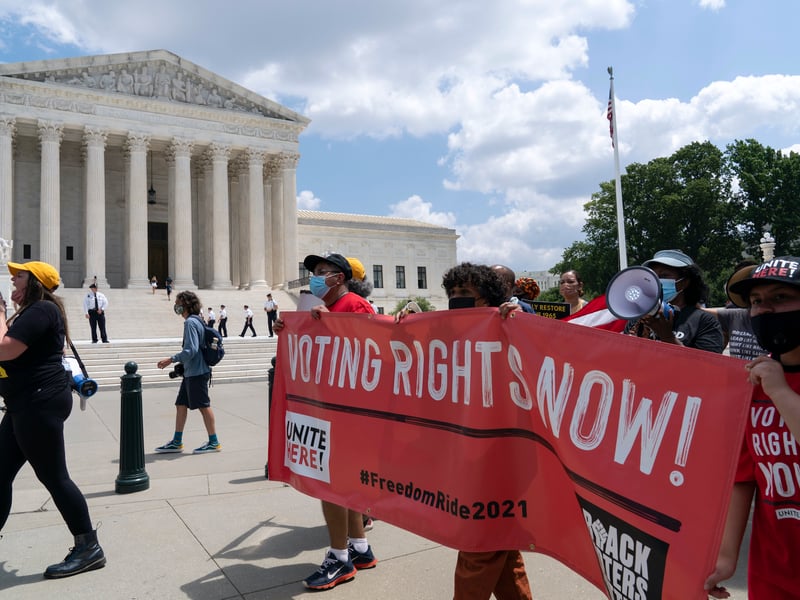
WASHINGTON (CN) — Sixty years after Bloody Sunday, the Voting Rights Act faces an existential challenge at the Supreme Court next week, pitting a vestige of the civil rights era against the justices’ shift toward a colorblind Constitution.
The justices are scheduled to hear arguments next week to decide if Louisiana violated the Equal Protection Clause when it added a second Black majority congressional district to comply with the Voting Rights Act.
Civil rights groups want the justices to uphold a vote dilution ruling, but a group of avowedly “non-African American voters” say the additional district is unconstitutional.
“We are still making that same march and making the same fights and arguments that we did back then,” Alanah Odoms, executive director of the ACLU of Louisiana, told reporters.
Louisiana reluctantly sided with civil rights groups but pitched the justices an alternative solution, completely revamping how the Voting Rights Act has been enforced for decades.
The state says it’s a “cruel irony” that courts are using the Voting Rights Act to require race-based sorting, such as the infamous majority in Plessy v. Ferguson believed.
“The divvying up of Americans by race is a stain on our nation’s history,” Louisiana wrote. “It should be a disgraced relic of the past. Regrettably, however, this court’s voting cases force the sovereign states to continue that vile practice today — penalizing states both when they consider race too little and when they consider race too much, all in the name of enforcing our ‘color-blind’ Constitution.”
For over a decade, the Supreme Court has been shifting toward the colorblind Constitution. As Chief Justice John Roberts, a George W. Bush appointee, put it in 2007, “The way to stop discrimination on the basis of race is to stop discriminating on the basis of race.”
Roberts reaffirmed that claim two years ago when he authored the court’s blockbuster ruling gutting affirmative action. However, Roberts also helmed an unexpected win for the Voting Rights Act in Allen v. Milligan , where the court rejected an effort to reshape Section 2 by including a “race-neutral benchmark.”
Justice Brett Kavanaugh, a Donald Trump appointee, joined Roberts and the court’s three liberal justices to form the majority but signaled skepticism of the Voting Rights Act, writing that its safeguards “cannot extend indefinitely into the future.”
The high court will be familiar with Louisiana’s case, ruling on multiple emergency applications on the dispute.
Civil rights groups in Louisiana brought a Section 2 claim against the Legislature for creating a sole majority Black district despite Black voters making up 30% of the voting-age population in the state.
The Supreme Court paused the redraw in 2022 — maintaining the single majority Black district for the midterm elections — while considering Alabama’s case. Last year, the justices offered another pause for the presidential election; however, they kept in place a newly drawn map with the second majority-Black district.
Self-described “non-African American” voters claimed the 2024 map violated equal protection because lawmakers used race to create a second majority-Black district. At the Supreme Court, they pushed the justices to curb Section 2.
“Section 2 is abused to set racial quotas and elevate some groups over others,” the voters wrote. “Such practices violate ‘the twin commands of the Equal Protection Clause that race may never be used as a ‘negative’ and that it may not operate as a stereotype.’”
Louisiana’s Sixth Congressional District includes a 250-mile stretch from Shreveport in the northwest to Baton Rouge in the southeast. The 2024 map increased that district’s Black voting age population from 24% to 54%. The state and civil rights groups argue that politics was the main driver of the new map — not race.
“In a state where Black communities have shaped the culture, the economy and the history, Louisiana’s congressional districts must reflect that reality, and anything less would be a betrayal of democracy itself,” Odoms said.
The civil rights groups say the lower court correctly applied precedent, but they worry the case will unravel the crux of the Voting Rights Act, cutting off a reliable path for resolving voter dilution claims.
Sarah Brannon, deputy director of the ACLU’s Voting Rights Project, said the justices could find that voter dilution claims cannot be resolved by federal courts.
“We would not be at all pleased with that outcome because it would set a very bad precedent going forward and make it very difficult for civil rights groups and minority voters to bring claims in the future to raise concerns that state legislatures are using race in a way that is intended not to help voters of color to have more opportunities to elect candidates of choice but to essentially manipulate race in such a way that would deprive voters of choice,” Brannon said.
President Donald Trump echoed the justices’ shift toward a colorblind Constitution as he targeted diversity, equity and inclusion policies throughout the public and private sectors.
The justices will hear arguments on March 24.
 Follow @KelseyReichmann
 Follow @kelseyreichmann.bsky.social
Subscribe to our free newsletters
Our weekly newsletter Closing Arguments offers the latest about ongoing trials, major litigation and rulings in courthouses around the U.S. and the world, while the monthly Under the Lights dishes the legal dirt from Hollywood, sports, Big Tech and the arts.